
- May 12, 2026
- Posted by: medconverge
- Category: Workplace Culture
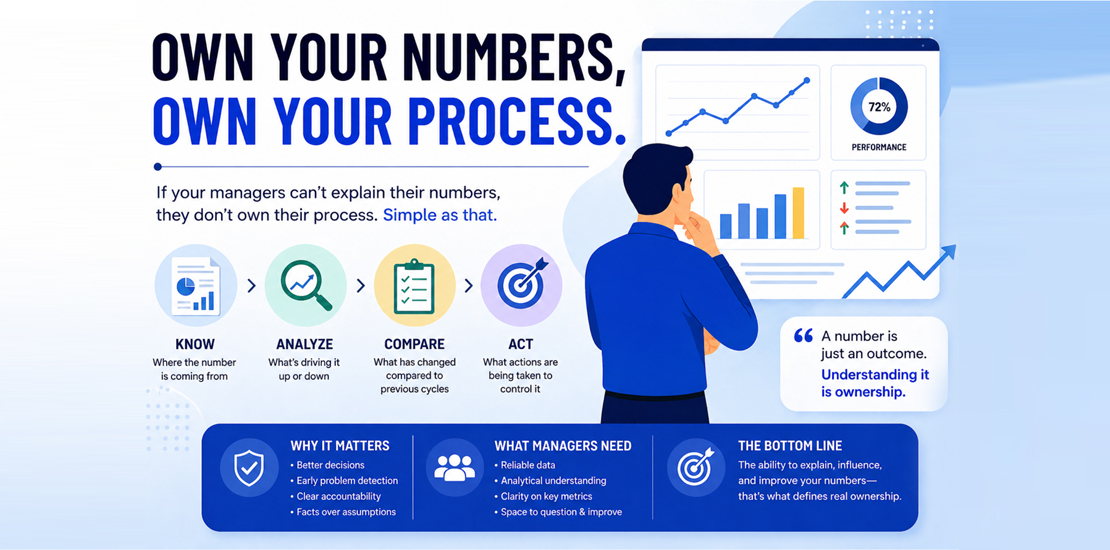
Managers Must Understand Their Numbers to Own the Process
If your managers can’t explain their numbers, they don’t own their process. Simple as that.
This may sound direct, but it’s not meant to point fingers. It’s meant to bring clarity to something most organisations quietly struggle with.
In many teams, numbers are everywhere. Dashboards are full, reports are shared, and reviews happen regularly. On the surface, it feels like everything is being tracked and controlled. But when you pause and ask a simple question: “Can you walk me through this number?” : The answers often fall apart.
You’ll hear things like:
- “That’s what the report shows.”
- “This came from the system.”
- “We saw a spike this week.”
- “The team was working on it.”
What’s missing is ownership.
Knowing a number is not the same as understanding it. And understanding it is not the same as being able to influence it.
A manager who owns their process should be able to clearly explain:
- Where the number is coming from
- What factors are driving it up or down
- What has changed compared to previous cycles
- What actions are being taken to control it
Not in complex language. Not with jargon. Just simple, clear reasoning.
Because when someone truly owns a process, the numbers are not just outcomes; they are signals. They tell a story. And that story should be easy to explain.
The Risk of Not Having This Clarity
The risk of not having this clarity is bigger than it appears.
When numbers are not understood:
- Decisions become reactive instead of planned
- Problems get identified late
- Accountability becomes unclear
- Teams start relying on assumptions instead of facts
Over time, this creates a gap between what is reported and what is actually happening on the floor.
This is where leadership often gets stuck. The data looks fine in meetings, but performance doesn’t match expectations. The issue isn’t always effort or intent; it’s a lack of real process ownership.
How to Build Better Process Ownership
The goal here isn’t to make managers defensive. It’s to raise the standard of how we look at performance.
A simple shift can help:
Ask for Explanations, Not Just Numbers
Instead of asking only for numbers, start asking for explanations.
Not aggressive questioning. Just consistent, thoughtful follow-ups:
- “What’s driving this trend?”
- “What changed from last week?”
- “Where do you see risk?”
- “What are you doing to control this?”
Over time, this builds a habit. Managers start looking beyond the surface. They begin to connect actions with outcomes. And slowly, ownership becomes visible.
What Managers Need to Succeed
It’s also important to support this change. If you expect managers to explain numbers, they need:
- Access to clean and reliable data
- Basic analytical understanding
- Clarity on what metrics actually matter
- The space to question and refine processes
Without this, you’re asking for accountability without giving control.
Conclusion
At its core, this isn’t about reporting. It’s about responsibility.
A number on a dashboard is not success. The ability to explain it, influence it, and improve it, that’s what defines ownership.
And once that becomes the norm, everything else starts to align more naturally.