
- June 13, 2026
- Posted by: medconverge
- Categories: Personality Development, Workplace Culture
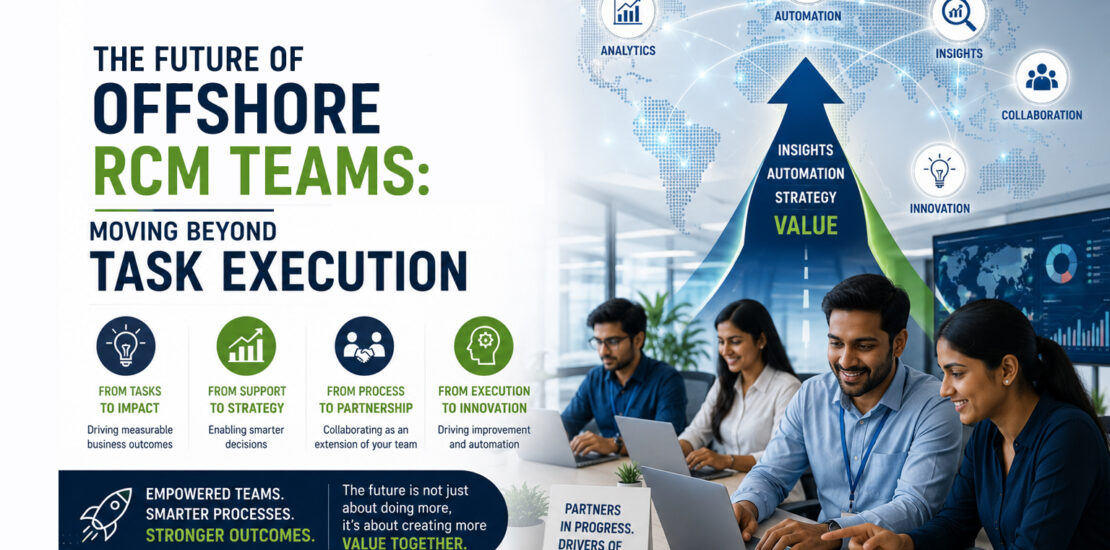
The Future of Offshore RCM Teams: Moving Beyond Task Execution
For many years, offshore Revenue Cycle Management (RCM) teams were primarily measured by one thing: output. How many claims were processed? How many accounts were worked on? How many tasks were completed within the agreed turnaround time?
Whilst productivity remains important, the expectations placed upon offshore teams are changing.
Healthcare organisations are under increasing pressure to improve financial performance, reduce operational costs, maintain compliance, and deliver a better patient experience. As a result, clients are no longer looking for vendors that simply complete tasks. They are looking for strategic partners who understand the wider impact of their work and contribute to measurable business outcomes.
As we move through 2026, successful offshore RCM teams will be distinguished not by the volume of work they process, but by the value they create.
Documentation Accuracy: The Foundation of Revenue Integrity
Many revenue cycle challenges can be traced back to inaccurate, incomplete, or inconsistent documentation.
A missing modifier, an overlooked diagnosis code, or incomplete clinical information can create a chain reaction that leads to claim rejections, payment delays, and increased administrative effort.
High-performing teams understand that documentation is not merely a compliance requirement. It is the foundation upon which the entire revenue cycle is built.
Investing in documentation knowledge, quality reviews, and continuous education helps teams identify issues before they become costly problems.
Denial Prevention Must Replace Denial Management
Traditionally, many RCM operations have focused heavily on denial resolution. Whilst recovering, denied revenue remains important; prevention is often far more valuable than correction.
Every denial represents additional work, delayed reimbursement, and unnecessary operational expense.
The most effective teams are shifting their focus towards identifying root causes, analysing denial trends, and implementing preventive measures. Whether the issue relates to eligibility verification, authorisations, coding accuracy, or payer requirements, preventing a denial is always more efficient than appealing one.
Organisations that build a prevention-first mindset often see improvements in both financial performance and operational efficiency.
Payer Knowledge Has Become a Competitive Advantage
Healthcare regulations continue to evolve, but payer-specific requirements often change even more frequently.
Each payer may have unique billing guidelines, documentation expectations, reimbursement policies, and claim submission requirements. A process that works successfully for one payer may not work for another.
RCM professionals who stay informed about these differences are able to reduce avoidable denials, improve first-pass claim acceptance rates, and resolve issues more efficiently.
In an increasingly complex reimbursement environment, payer knowledge is no longer a specialist skill. It has become a core operational requirement.
Balancing Productivity with Quality
One of the most common mistakes in operational management is treating productivity and quality as separate objectives.
When productivity becomes the sole focus, quality often suffers. Errors increase, rework grows, and overall efficiency declines. Conversely, excessive focus on perfection can create bottlenecks and reduce throughput.
The strongest RCM teams understand that sustainable performance requires balance.
Success should not be measured purely by volume. It should also reflect accuracy, compliance, turnaround times, denial rates, and client satisfaction. Teams that maintain this balance consistently deliver better long-term results.
Effective Client Communication Matters More Than Ever
Technical expertise alone is no longer enough in a client-facing environment.
Healthcare organisations increasingly expect offshore teams to communicate clearly, professionally, and confidently. Whether discussing operational performance, reporting trends, or resolving challenges, communication plays a significant role in building trust.
Strong communication helps prevent misunderstandings, strengthens client relationships, and demonstrates accountability.
The ability to explain not only what has happened, but why it has happened and how it can be improved, is becoming an increasingly valuable skill across all levels of RCM operations.
Data Should Drive Decisions
Many operational teams collect large volumes of data but fail to use it effectively.
Reports, dashboards, and performance metrics have little value unless they influence decision-making.
The most successful RCM teams use data to identify trends, understand root causes, measure outcomes, and prioritise improvement initiatives. Rather than relying on assumptions, they use evidence to guide their actions.
Data-driven organisations are often better positioned to respond to challenges, improve performance, and support client objectives.
Understanding the “Why”
Perhaps the biggest shift taking place within offshore RCM operations is the move from task ownership to outcome ownership.
Employees who understand only the task in front of them may complete the work correctly. Employees who understand the reason behind the task are more likely to identify risks, suggest improvements, and contribute to broader organisational goals.
When teams understand how their actions affect cash flow, compliance, patient experience, and client success, they become more engaged and more effective.
That deeper understanding transforms employees from processors of work into contributors to business performance.
Looking Ahead
The future of offshore RCM lies in knowledge, accountability, and operational insight.
Documentation accuracy, denial prevention, payer expertise, balanced productivity, effective communication, and data-driven decision-making will continue to shape successful teams in 2026 and beyond.
The organisations that thrive will not be those with the largest teams or the highest volumes. They will be the ones who invest in developing professionals who understand both the mechanics of the revenue cycle and the business impact of their work.
After all, the greatest value is created when people understand not only what they do, but why they do it.