
- June 30, 2026
- Posted by: medconverge
- Category: RCM
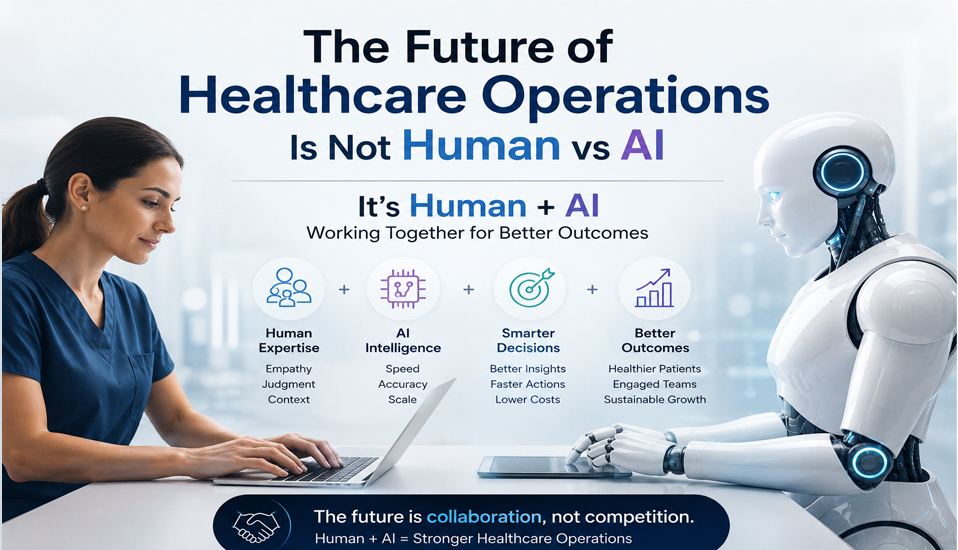
The Future of Healthcare Operations Is Not Human vs AI
Few topics have generated as much discussion in recent years as Artificial Intelligence.
Across industries, organisations are exploring how AI can improve productivity, reduce manual effort and support better decision-making. Healthcare operations and Revenue Cycle Management (RCM) are no exception. From automating routine processes to analysing large volumes of data, AI is already beginning to change the way many teams work.
With every new technological development, however, a familiar question emerges:
Will AI replace people?
The more useful question may be:
How can people and AI work together more effectively?
The future is unlikely to be a contest between humans and technology. Instead, it will belong to organisations and professionals who understand how to combine the strengths of both.
Technology Is Transforming Operational Work
Many of the tasks that once consumed significant amounts of time can now be completed more efficiently with the support of technology.
AI can generate reports in seconds.
It can identify trends across thousands of transactions.
It can summarise information, flag anomalies, and automate repetitive administrative activities.
These capabilities create enormous opportunities for healthcare organisations. Teams can spend less time gathering information and more time using it. Processes become more efficient, and operational leaders gain access to insights that were previously difficult to obtain.
This shift should be viewed as an evolution of work rather than a replacement of it.
Throughout history, technology has consistently changed how people work. What it has rarely done is eliminate the need for human contribution.
The Human Skills That Technology Cannot Replicate
Whilst AI can process information at extraordinary speed, there are aspects of professional life that remain fundamentally human.
Trust is one of them.
Clients do not build long-term relationships with software. They build relationships with people. Trust is developed through consistency, credibility, transparency and reliability over time.
Judgement is another.
Data can provide recommendations, but business decisions often involve context, competing priorities and considerations that extend beyond what any system can measure. Experienced professionals bring perspective and practical understanding that technology alone cannot provide.
Leadership also remains distinctly human.
Teams need direction, encouragement and support. They need leaders who can navigate uncertainty, make difficult decisions and bring people together around a common goal.
Technology can provide information. Leadership provides purpose.
Why Empathy Still Matters
Healthcare, at its core, is a people-focused industry.
Whether supporting patients, providers, clients or colleagues, human interaction remains essential. Empathy plays a significant role in understanding concerns, resolving issues and building meaningful relationships.
No matter how advanced technology becomes, people still want to feel heard, understood and respected.
Empathy helps managers support their teams during periods of change. It helps client-facing professionals build stronger partnerships. It helps organisations maintain a culture where people feel valued rather than treated as numbers on a report.
These qualities remain difficult to automate because they depend upon genuine human understanding.
The Professionals Who Will Thrive
As AI becomes more common, the most successful professionals will not be those who resist technological change.
Nor will they be those who rely entirely on technology to think of them.
The individuals who thrive will be those who learn how to work alongside new tools whilst continuing to strengthen the skills that technology cannot replace.
They will understand healthcare operations.
They will be comfortable using data and technology.
They will communicate effectively.
They will build relationships.
They will exercise sound judgement.
Most importantly, they will recognise that technology is a tool designed to enhance human capability rather than diminish it.
A New Opportunity for Healthcare Operations
For healthcare organisations, AI presents an opportunity to rethink how value is created.
When repetitive activities are automated, employees can spend more time focusing on analysis, problem-solving, client engagement and strategic improvement initiatives. Teams become more productive without sacrificing quality. Leaders gain better visibility into performance. Organisations become more agile and responsive.
The real advantage comes not from having access to technology, but from having people who know how to use it effectively.
Technology alone does not create transformation.
People do.
Looking Ahead
Artificial Intelligence will continue to influence healthcare operations in the years ahead. Its capabilities will expand, and its role within organisations will become increasingly significant.
Yet the qualities that define great professionals are unlikely to change.
Trust.
Judgement.
Leadership.
Relationship building.
Empathy.
These remain essential regardless of how sophisticated technology becomes.
The future is not a choice between humans and AI.
It is about combining the efficiency of technology with the strengths that only people can bring.
The professionals who embrace that reality will be the ones leading the next generation of healthcare operations and Revenue Cycle Management.