
- May 24, 2026
- Posted by: medconverge
- Category: AR Calling
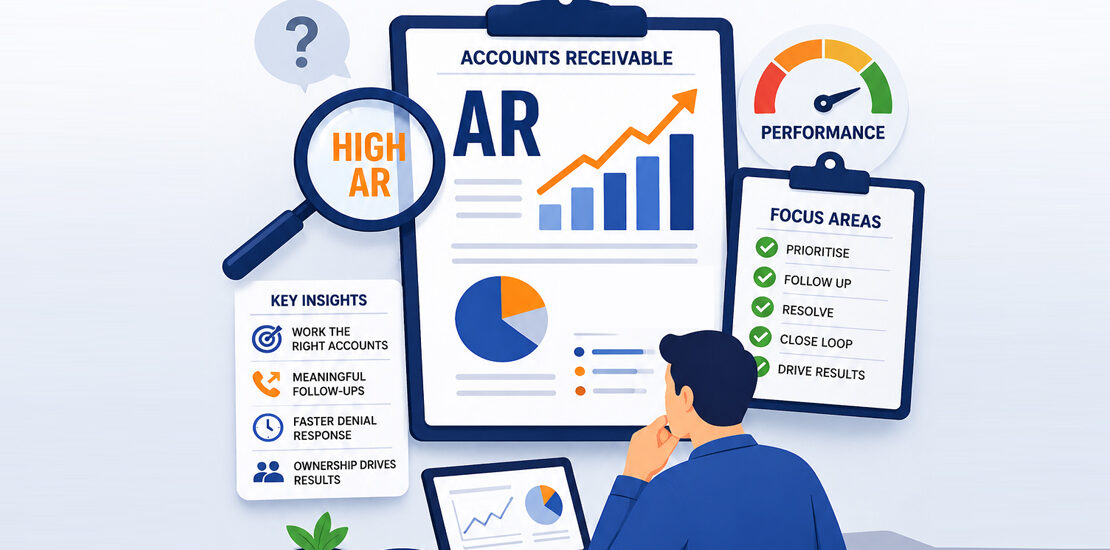
High AR doesn’t always mean your collections are weak.
That assumption sounds logical on the surface, but in reality, it’s often the wrong conclusion.
If you’ve spent even a little time in Revenue Cycle Management, you’ll know this: numbers rarely tell the full story on their own. AR is one of those metrics that gets judged quickly, but understood slowly.
Let’s break this down properly.
The Common Misunderstanding Around AR
When accounts receivable start climbing, the immediate reaction in most teams is panic.
“Collections are down.”
“Follow-ups are not happening.”
“Team productivity is low.”
Sometimes that’s true. But not always.
High AR can just as easily point to how work is being handled, not how much work is being done.
What High AR Might Actually Be Telling You
Before jumping to conclusions, it’s worth asking a few sharper questions.
1. Are we working the right accounts first?
If your team is spending time on low-value or low-impact claims while high-value claims sit untouched, AR will build up quickly, even if the team is “busy” all day.
Prioritisation is everything in AR. Not all dollars are equal.
2. Are follow-ups meaningful or mechanical?
There’s a difference between making a call and moving a claim.
If follow-ups are just status checks without intent, no escalation, no documentation, no ownership, the claim stays where it is. On paper, the activity looks high. In reality, nothing is progressing.
3. How fast are we reacting to denials?
Delays kill momentum.
A denial worked after 2 days is very different from one touched after 10 days. The longer it sits, the harder it becomes to recover, and the more it inflates your AR.
4. Are we closing loops or just touching accounts?
A lot of AR teams fall into a pattern of “touch and move on.”
But strong AR performance comes from closure:
- Was the issue resolved?
- Was the payer response verified?
- Is the next action clearly defined?
If not, the same claims keep coming back, quietly increasing AR.
What Actually Improves AR Performance
Now let’s talk about what works, not in theory, but in real operations.
Clear Work Queues
Segment accounts based on value, ageing, and payer behaviour. Give your team clarity on what needs attention first.
Defined Follow-Up Standards
Every follow-up should have a purpose:
- What outcome are we aiming for?
- What’s the next step if we don’t get it?
Without this, follow-ups become routine instead of results-driven.
TAT Discipline on Denials
Set internal timelines for working on denials, and stick to them. Speed matters more than volume here.
Ownership at the Claim Level
When too many people touch the same account without accountability, progress gets diluted. Assign ownership wherever possible.
Actionable Reporting (Not Just Numbers)
AR reports shouldn’t just show totals. They should answer:
- Where are we losing time?
- Which payers are causing delays?
- What kind of errors are repeating?
If your reports don’t help you act, they’re just decoration.
Who This Matters For
If you’re an AR caller, this changes how you approach your day. It’s not about how many calls you make, it’s about how many claims you move.
If you’re a team lead, this shifts how you evaluate performance. Activity alone isn’t a reliable indicator anymore.
And if you’re someone trying to move into operations, understanding this is critical. Because at that level, you’re not managing tasks, you’re managing outcomes.
The Bottom Line
High AR is not a problem statement. It’s a symptom.
And like any symptom, it needs to be diagnosed properly before it’s treated.
Sometimes the issue is collections.
But often, it’s structure, prioritisation, and follow-through.
The difference between average AR teams and strong ones isn’t effort.
It’s clarity.
And once that clicks, the numbers usually start correcting themselves.