
- June 28, 2026
- Posted by: medconverge
- Category: RCM
Beyond the Dashboard: Why Human Judgement Still Matters
Organisations today have access to more information than at any other point in history.
Every transaction, workflow, interaction and outcome can be measured, analysed and presented through increasingly sophisticated systems. Healthcare organisations and Revenue Cycle Management (RCM) teams now rely on dashboards, reports, predictive analytics and automation tools to monitor performance and identify opportunities for improvement.
Yet despite these advances, one reality remains unchanged.
Data can provide information, but people still make decisions.
As technology continues to evolve, the organisations that achieve the greatest success will not necessarily be those with the most data. They will be the ones with professionals who know how to interpret that data, understand its implications and turn insights into meaningful action.
Information Is Everywhere. Insight Is Not.
Many businesses have invested heavily in reporting tools and performance dashboards. Metrics are available at the click of a button, and operational leaders can access more information than ever before.
The challenge is that information alone does not automatically lead to better outcomes.
A dashboard may show that denial rates have increased. A report may reveal a decline in productivity. A trend analysis may identify a recurring issue affecting revenue performance.
However, these tools rarely explain the full story.
Understanding why something is happening requires investigation, experience and critical thinking. It requires professionals who can connect the numbers to the operational realities behind them.
Without interpretation, data remains little more than a collection of figures.
Technology Can Highlight Problems, But People Solve Them
Automation and analytics have transformed healthcare operations in many positive ways.
Tasks that once required significant manual effort can now be completed more efficiently. Patterns can be identified more quickly. Potential risks can be flagged before they become major issues.
However, technology typically identifies what is happening rather than determining what should happen next.
Consider a report showing a rise in claim denials. The data may reveal the trend, but it takes knowledgeable professionals to determine the root cause. Is it a documentation issue? A payer policy change? A training gap? A process failure?
The solution often depends upon judgement, experience and collaboration.
Technology supports decision-making. It does not replace it.
The Importance of Context
One of the limitations of data is that it does not always capture context.
Two organisations may have identical performance metrics but face entirely different circumstances. A decline in productivity may be caused by a system issue in one team and a staffing challenge in another.
Looking at numbers without understanding context can lead to poor decisions.
Strong leaders recognise that metrics should start conversations rather than end them. They use data as a guide whilst also considering operational realities, employee feedback, client expectations and broader business objectives.
Numbers become far more valuable when viewed alongside human insight.
Data Literacy Is Becoming a Leadership Skill
As organisations become increasingly data-driven, leaders at every level need to develop a stronger understanding of analytics.
This does not mean becoming a data scientist or technical specialist. It means being able to interpret trends, ask the right questions and understand what information is most relevant to decision-making.
Effective leaders know how to distinguish between activity and performance. They understand the difference between short-term fluctuations and long-term trends. Most importantly, they avoid making decisions based solely on isolated metrics.
Data literacy is no longer a specialist capability. It is becoming an essential leadership skill.
Turning Information into Action
The organisations that gain the most value from data are not necessarily those with the most advanced technology.
They are the organisations that create a culture of action.
When trends are identified, they investigate the causes. When opportunities emerge, they act on them. When performance improves, they understand why and seek ways to replicate success.
This ability to move from information to action often determines whether analytics becomes a competitive advantage or simply another reporting exercise.
Data creates awareness.
Action creates results.
The Human Advantage
As Artificial Intelligence and automation continue to advance, some aspects of work will undoubtedly become more efficient and more automated.
However, certain strengths remain distinctly human.
Critical thinking.
Professional judgement.
Relationship building.
Communication.
Strategic decision-making.
These qualities allow people to interpret information, weigh competing priorities and make decisions that technology alone cannot fully replicate.
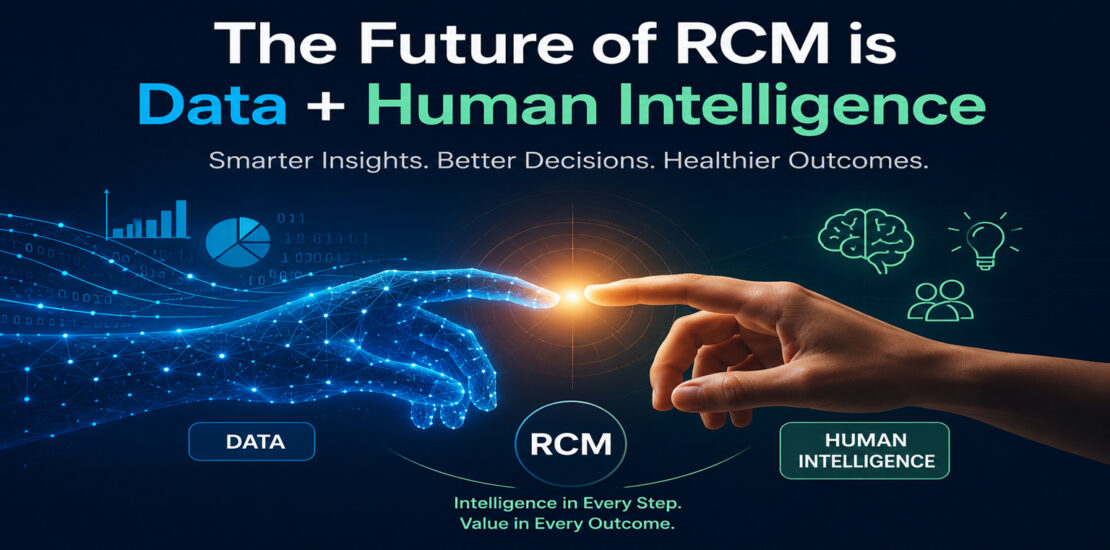
The future of healthcare operations and RCM will not be shaped by technology in isolation. It will be shaped by professionals who know how to combine technology, data and human judgment to improve outcomes.
Looking Ahead
Data can identify trends.
Technology can automate processes.
Dashboards can highlight opportunities.
But meaningful progress still depends upon people who can understand what the numbers are saying and decide what to do next.
The most valuable professionals of the future will not simply collect information. They will transform information into action.
Because numbers tell a story.
The strongest leaders are the ones who know how to read it—and, more importantly, what to do once they have.