
- October 25, 2026
- Posted by: medconverge
- Categories: Medical Billing, RCM
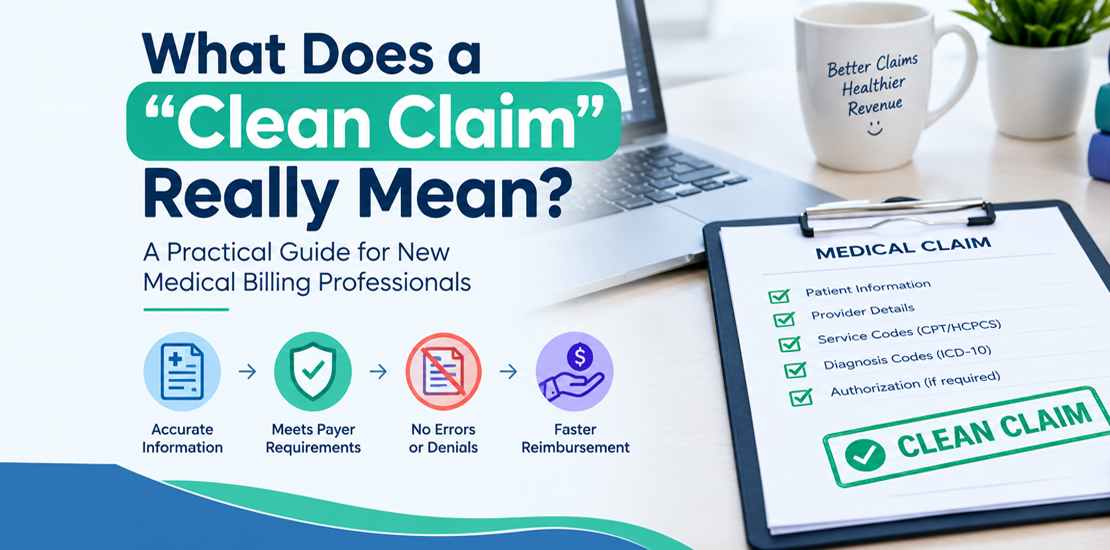
What Does a “Clean Claim” Really Mean? A Practical Guide for New Medical Billing Professionals
Ask someone new to medical billing what a clean claim is, and you may hear:
“A claim that doesn’t get denied.”
That’s understandable.
But it doesn’t tell the whole story.
A clean claim is one that contains the information required for accurate and timely processing, without avoidable errors or missing details.
For someone starting a career in medical billing, understanding this concept early can make the rest of the revenue cycle much easier to understand.
Let’s break it down.
Start with the Patient
Start with the patient.
A claim begins with basic patient information.
Names, dates of birth, identification numbers and other demographic details need to be accurate and consistent with the available records.
A small error here can create a much larger problem later.
For example, incorrect information can affect claim matching or payer processing.
Accuracy starts before the claim reaches the payer.
Check the Insurance Information
Check the insurance information
The claim also needs to be connected to the correct coverage.
Important details can include:
- Payer information
- Member or policy details
- Group information where applicable
- Coverage status
- Relevant plan information
This is one reason eligibility work matters so much to the wider revenue cycle.
If coverage information is wrong at the beginning, the billing team may spend time dealing with a problem that started earlier.
Provider Information Matters
Provider information matters
The claim also needs the appropriate provider information.
Depending on the claim and workflow, this may include identifiers, billing provider details, rendering provider information and other required fields.
The key point for a new biller is simple:
Never assume that provider information is correct simply because it appeared on a previous claim.
Verify according to the applicable process.
Diagnosis Codes
Diagnosis codes
Diagnosis codes communicate the conditions or circumstances documented for the encounter.
The codes selected must be supported by the documentation and follow applicable coding requirements.
Billing professionals don’t independently decide clinical coding simply to make a claim process easier.
The information submitted should reflect the underlying documentation and the work performed by the appropriate professionals.
Procedure Codes
Procedure codes
Procedure codes describe the services or procedures being billed.
The relationship between the documented service and the submitted code matters.
A claim may contain all the expected fields and still face a problem if the service information does not accurately represent what occurred.
That is why coding and billing need to work closely together.
Don’t Overlook Modifiers
Don’t overlook modifiers.
Modifiers can provide additional information about a billed service when applicable.
For someone new to billing, the important lesson is not to treat modifiers as optional decorations attached to a code.
Their use should be supported by the circumstances of the service and the applicable coding guidance.
Incorrect use can create processing problems just as easily as failing to use one when required.
Authorization
Authorization
Some services may require prior authorisation or another form of approval depending on the payer, plan and circumstances.
If an authorisation is required, the relevant information needs to be handled correctly.
An authorisation issue discovered after the service has been performed can become much harder to resolve.
That is why authorisation belongs in the conversation before claim submission—not only after a problem occurs.
Medical Necessity
Medical necessity
Another important consideration is whether the documentation and coding support the medical necessity requirements applicable to the service and payer.
This is one area where simply asking, “Did we submit the claim?” is not enough.
The bigger question is:
Does the claim accurately communicate the service and supporting information required for processing?
Claim Formatting
Claim formatting
Claims also need to meet applicable formatting and submission requirements.
Information may be correct individually but still create a problem if it is placed incorrectly, omitted or transmitted in an unacceptable format.
Billing professionals therefore need to understand both the information itself and how it moves through the claim process.
Common Avoidable Issues
Common avoidable issues
Some claim problems are not complicated.
They come from basic details being overlooked.
Examples include:
- Incorrect patient information
- Incorrect insurance details
- Missing required information
- Coding inconsistencies
- Missing authorisation information
- Incorrect provider details
- Formatting issues
- Incomplete documentation
These are exactly the kinds of issues that good pre-submission checks can identify.
Why Clean Claims Matter
Why clean claims matter
A clean claim isn’t about achieving a perfect-looking report.
It is about giving the payer the information needed to process the claim accurately and without avoidable obstacles.
Every preventable issue creates additional work somewhere.
It may return to billing.
It may require clarification.
It may lead to rework.
It may delay payment.
And eventually, someone has to spend time resolving it.
That is why clean-claim practices matter to the wider revenue cycle.
For Someone Starting in Medical Billing
For someone starting in medical billing
The most useful habit is to stop thinking of the claim as a form that needs to be filled out.
Think of it as a communication.
The claim tells the payer:
Who received the service?
Who provided it?
What was performed?
Why was it performed?
What coverage applies?
What information supports processing?
When those pieces are accurate and appropriately presented, the claim has a stronger foundation.
The Takeaway
The takeaway
A clean claim is not simply a claim that escaped denial.
It is the result of several pieces of work coming together correctly.
For a new medical billing professional, learning that connection early provides a much stronger foundation for understanding the revenue cycle.
Good billing starts with good information.
And good information starts with attention to detail.
Want to Build a Career in Medical Billing?
Want to build a career in medical billing? Start with the fundamentals, understand how each part connects, and build practical knowledge through structured training with MedConverge.