
- October 13, 2026
- Posted by: medconverge
- Category: RCM
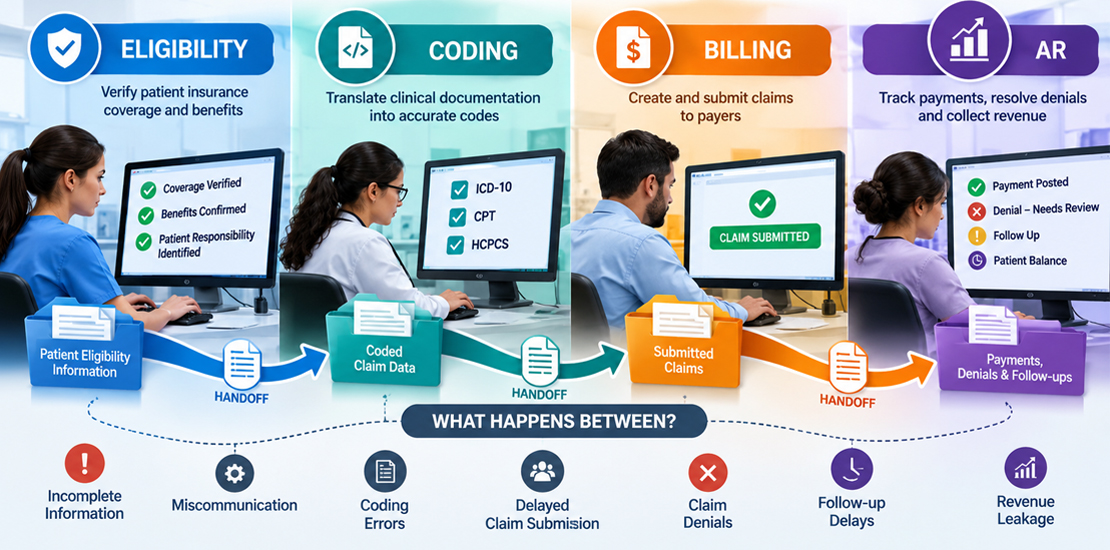
The RCM Handoff Problem: What Happens Between Eligibility, Coding, Billing and AR?
Revenue cycle management is usually described as a sequence.
- Eligibility.
- Coding.
- Billing.
- Claim submission.
- Payment posting.
- Accounts receivable.
It sounds straightforward when written as a list.
The reality is different.
Each stage depends on information coming from the stage before it. When that information is incomplete, unclear or delayed, the next team inherits the problem.
That is where one of the less visible RCM challenges appears:
the handoff.
A department can perform well within its own responsibilities, and the overall revenue cycle can still struggle if information does not move properly between teams.
Eligibility → Coding
The first handoff begins with the information surrounding the patient and the encounter.
Eligibility work can establish important insurance and coverage information. That information needs to remain accessible and usable as the account moves forward.
When details are missing or unclear, the downstream team may spend time trying to establish what should already be known.
The lesson is simple:
Information gathered early has value only when it reaches the people who need it.
Coding → Billing
Coding and billing are closely connected.
The billing team depends on the coded information, documentation and other claim details needed to prepare a submission.
When something doesn’t align, the issue may not become obvious until the claim reaches the next stage.
This is why communication between coding and billing matters.
A strong handoff gives the receiving team enough context to proceed without unnecessary clarification or rework.
Billing → Payer
Once a claim leaves the organisation, another transition begins.
The claim enters the payer’s processing environment.
At this point, accuracy matters because the payer will evaluate the information submitted against its own processing rules and requirements.
A problem identified here may appear as a rejection, denial, delay or payment difference.
The billing team may have completed its task, but from an operational perspective, the work is not finished.
The outcome still matters.
Payer → Payment Posting
A payer response contains information that needs to be interpreted correctly.
Payment posting teams may need to work with payment information, adjustments, patient responsibility and other details associated with the claim.
A payment amount alone does not tell the entire story.
The receiving team needs to understand what happened to the account and how the payer’s response affects the remaining balance.
A weak handoff here can create confusion further down the line.
Payment Posting → AR
Now the question changes.
Which accounts actually need follow-up?
Not every unpaid amount represents the same situation.
Some accounts may require payer follow-up.
Others may involve patient responsibility, contractual adjustments, missing information or another unresolved issue.
The AR team depends on the preceding work to understand what action is appropriate.
If the account history is incomplete, the first task may become investigation rather than resolution.
That adds time without necessarily adding value.
Where Handoffs Usually Become Difficult
Several problems can make transitions harder:
Incomplete information
The next team receives an account but not the information needed to act.
Unclear ownership
Everyone knows there is a problem, but nobody is certain who should resolve it.
Delayed communication
Important information reaches the next function after the account has already moved forward.
Different definitions
Two teams may use the same term but measure or interpret it differently.
Repeated rework
An issue moves backwards through the process because it wasn’t addressed during the first opportunity.
Measure the Handoff, Not Just the Department
Most operational reviews ask:
How is my team performing?
That’s an important question.
But it should be followed by another:
How well does our work move to the next team?
For example, a team may have excellent productivity numbers while the receiving department spends significant time correcting or clarifying its output.
The first number looks good.
The overall process does not.
This is why mature RCM operations need measures that look beyond individual departmental targets.
Consider tracking:
- Handoff-related rework
- Missing information
- Clarification requests
- Returned accounts
- Repeat errors
- Turnaround between functions
- Issues originating upstream
These measures can reveal problems that individual productivity reports may not show.
Fixing the Space Between Teams
Improving handoffs does not always require a major technology project.
Sometimes the solution is much simpler:
- A clearer checklist.
- A defined ownership rule.
- A standard handoff format.
- Better documentation.
- A shared quality definition.
- A short feedback loop between teams.
The important thing is to identify where information gets lost, changed or delayed.
The Bigger Picture
The revenue cycle does not break only inside individual processes.
Sometimes it breaks between them.
When eligibility, coding, billing, payment posting and AR operate as isolated functions, each team may focus on completing its own work.
When they operate as connected stages of one process, the focus changes.
The question becomes:
What does the next team need from us to do its job correctly?
That is a much stronger way to look at RCM.
Because a revenue cycle is only as strong as the connections between its moving parts.
The best-performing teams don’t just complete their portion of the work. They make the next step easier.