
- September 23, 2026
- Posted by: medconverge
- Category: RCM
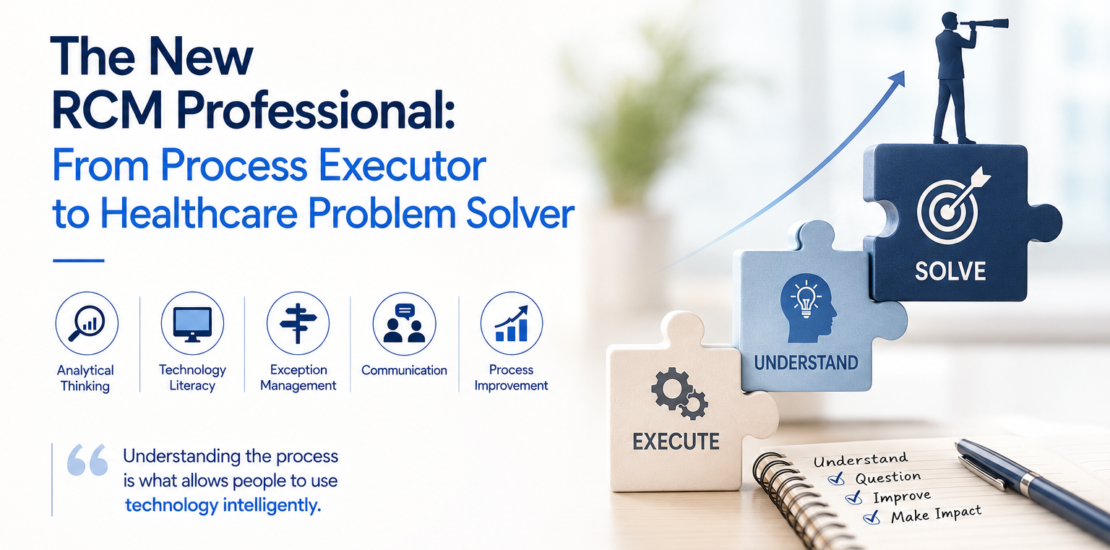
The New RCM Professional: From Process Executor to Healthcare Problem Solver
For years, many healthcare RCM roles have been built around mastering processes.
Process the account.
Review the claim.
Follow up with the payer.
Post the payment.
Work the denial.
Meet productivity and quality expectations.
These responsibilities still matter.
But the nature of RCM work is changing.
As automation, analytics and AI take over more repetitive activities, the value of an RCM professional will increasingly depend on what they can contribute beyond completing the task.
The question is no longer simply:
“Can you process the work correctly?”
It is becoming:
“Can you understand the work well enough to make it better?”
That shift will influence how RCM professionals build their careers and how organisations develop their teams.
The Fundamentals Still Matter
The future of RCM does not mean moving away from the basics.
A strong RCM professional still needs to understand:
- Medical terminology
- Coding and billing concepts
- Insurance and payer requirements
- Claim workflows
- Documentation
- Revenue-cycle processes
- Quality and productivity expectations
These skills remain the foundation.
Technology can identify a pattern or recommend an action, but professionals need enough domain knowledge to determine whether that recommendation actually makes sense.
From Processing to Problem Solving
Consider two employees working on the same recurring denial.
The first corrects the account, documents the action and moves to the next case.
The second does the same but then asks:
- Why did this happen?
- Could it have been prevented?
- Is the same issue occurring elsewhere?
- Is there a payer-specific pattern?
- Does the process need to change?
Both employees completed the task.
But the second employee has gone one step further: they have started solving the problem behind the task.
That is the shift from process executor to problem solver.
And it is where professional value begins to expand.
Five Capabilities That Will Matter More
1. Analytical Thinking
Data is becoming more accessible across healthcare operations.
The valuable skill is not simply reading a dashboard. It is knowing what questions to ask.
- Why did denial rates increase?
- Why has ageing moved?
- Why is one payer behaving differently?
- Why is one team seeing a different pattern?
2. Technology Literacy
RCM professionals do not need to become software engineers.
But they increasingly need to understand what automation and AI can do, where they can assist, what information systems depend on, and when an automated recommendation needs human review.
Technology literacy is becoming part of operational literacy.
3. Exception Management
Routine transactions are generally easier to automate.
Healthcare also has plenty of cases that do not fit neatly into a rule.
Unusual claims, payer-specific situations, documentation issues and unexpected outcomes will continue to require investigation.
As routine work becomes more automated, the ability to understand and manage exceptions may become one of the most valuable RCM skills.
4. Communication
As professionals progress, they need to explain problems to more people.
Team members. Managers. Clients. Quality teams. Technology teams. Cross-functional stakeholders.
Understanding a problem is important.
5. Process Improvement
A process executor asks:
“How do I complete this?”
A problem solver also asks:
“Why do we do it this way?”
That question can uncover unnecessary steps, repeated rework, unclear ownership and opportunities for improvement or automation.
Many meaningful process improvements begin when someone questions something that has simply become “the way we do things.”
The Questions Change as You Grow
Career progression in RCM is not only about moving from one title to another.
It is also about taking on more complex questions.
An entry-level professional may ask:
“What do I need to do?”
An experienced professional asks:
“How do I do this correctly and consistently?”
An SME asks:
“Why is this happening?”
A team leader asks:
“How can we help the team perform better?”
A manager asks:
“How is this affecting the operation and the business?”
A senior leader asks:
“What should we change about the way the work is designed?”
It is a thinking ladder.
What This Means for RCM Organisations
The changing role of the RCM professional also changes how organisations should approach training and development.
Process knowledge and productivity will continue to matter. But future-ready teams also need opportunities to develop analytical thinking, problem-solving, technology awareness, communication and process-improvement skills.
Employees should be encouraged not only to follow a process, but to understand its purpose and question recurring problems.
When someone identifies the same issue repeatedly, the goal should not always be to teach them how to work the issue faster.
Sometimes the better question is:
That is where operational efficiency becomes continuous improvement.
The RCM Professional of Tomorrow
The future RCM professional will not necessarily be the person who knows every answer.
They will be someone who knows how to find the right answer.
They will understand the process, recognise patterns, use data, work confidently with technology and know when human judgement is required.
Most importantly, they will look beyond the individual transaction and understand how their work affects the broader revenue cycle.
Because completing a task accurately and improving an outcome are not the same thing.
Final Thought
Healthcare RCM will always need professionals who can execute processes accurately.
But as technology takes over more routine work, execution alone will become a smaller part of professional differentiation.
The greater opportunity will be to understand the work, question it, improve it and connect it to the broader business outcome.
Problem-solving capability moves you forward.
Business understanding prepares you for leadership.
That is the direction in which the RCM career is evolving.
At MedConverge, we believe building a future-ready RCM workforce requires more than teaching people how to complete processes. It requires developing the knowledge, judgement and problem-solving capability to make those processes better.
They will understand the problem behind it and help solve it.
Follow MedConverge for practical insights on healthcare RCM, careers, technology, workforce development and process excellence.