
- September 28, 2026
- Posted by: medconverge
- Category: RCM
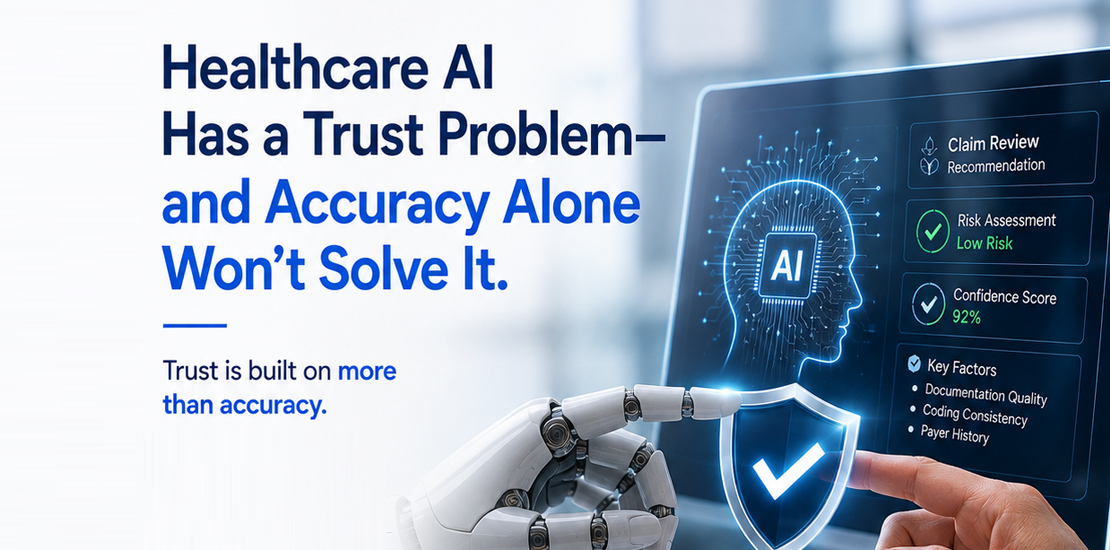
The Healthcare AI Conversation Is About Accuracy
The healthcare AI conversation often revolves around one number:
Accuracy.
How accurate is the model?
How often does it identify the correct outcome?
How much time does it save?
Those questions matter.
But healthcare requires something more difficult to measure.
Trust.
A system can be highly accurate and still be difficult to trust.
That may sound contradictory, but consider what happens when an AI system makes a recommendation that affects a claim, a coding decision, a documentation review or an operational workflow.
If the system gets it right, the organisation benefits.
But what happens when it gets it wrong?
- Can someone understand why the recommendation was made?
- Can the decision be challenged?
- Is there a clear human review process?
- Can the organisation identify whether the error was an isolated event or part of a recurring pattern?
From “Can AI Do This?” to “Can We Safely Trust AI to Do This?”
These questions are becoming increasingly important as India’s healthcare AI ecosystem moves toward more responsible and structured adoption. Initiatives such as SAHI and BODH reflect a broader movement toward ethical, transparent and evidence-oriented approaches to healthcare AI.
The conversation is gradually shifting from:
“Can AI do this?”
to:
“Can we safely trust AI to do this?”
That is a much more important question.
Accuracy Does Not Tell the Whole Story
Accuracy tells us how often a system may be right.
It doesn’t necessarily tell us whether the system is understandable, accountable or appropriate for a particular decision.
Imagine an AI system that performs extremely well overall but incorrectly flags a legitimate claim as high risk.
The operational problem is not simply that the model made a mistake.
The reviewer now needs to know:
- why the claim was flagged
- whether the recommendation makes sense
- whether human intervention is required
- whether the system has a recurring blind spot
- how the exception should be documented
In other words, the organisation needs a way to respond to the AI’s decision, not merely a score showing how accurate the AI has historically been.
Why Explainability Matters
This is where explainability becomes important.
An employee does not necessarily need to understand the model’s underlying mathematics or technical architecture.
But they may need enough context to understand why the system reached a particular recommendation.
A simple message saying “High risk” may not be sufficient.
A more useful system might:
- indicate the factors that contributed to the recommendation
- provide relevant context
- allow the reviewer to determine whether the recommendation makes sense
Explainability therefore isn’t about exposing every line of code.
It is about giving the people responsible for an outcome enough information to exercise appropriate judgement.
AI Should Not Automatically Become the Final Decision-Maker
That leads to another important principle:
AI should not automatically become the final decision-maker simply because it is faster.
For many healthcare operational applications, a more sensible model may be:
AI identifies → Human reviews → Human decides → System learns
This doesn’t mean humans need to check every routine transaction forever.
In fact, one of the greatest benefits of AI may be reducing the amount of routine work that requires human attention.
The human role can increasingly shift toward exceptions, ambiguity, oversight and decisions where context matters.
That is not the replacement of human judgement.
It is the redesign of where human judgement creates the most value.
The Quality of Data Matters
There is another challenge that receives less attention than accuracy: the quality of the data itself.
AI learns from data.
If the underlying data is incomplete, inconsistent, poorly classified or biased, the model can reproduce those problems in its outputs.
That creates a fundamental question:
Is the model wrong, or is the data teaching it the wrong lesson?
Sometimes the answer will be the model.
Sometimes it will be the data.
And sometimes the problem will sit in the process used to collect, label or interpret that data.
Responsible AI Is Not Just an IT Initiative
This is why responsible AI cannot be treated purely as an IT initiative.
Healthcare operations, technology, compliance, data and business teams all have a role to play in determining whether an AI system is actually appropriate for use.
Privacy and Security in Healthcare AI
Privacy and security add another layer.
Healthcare information is inherently sensitive, which means AI adoption must be considered alongside:
- access controls
- data governance
- privacy
- security
- auditability
- appropriate use
A technology solution cannot be considered successful simply because it produces an impressive output.
The organisation also needs confidence that the information being used is being handled appropriately.
What Healthcare AI Means for RCM
This becomes particularly relevant to RCM.
As intelligent systems become more capable, RCM professionals may increasingly interact with AI-generated recommendations rather than performing every task manually.
They may need to:
- review recommendations
- identify unusual outputs
- understand confidence or risk indicators
- challenge incorrect conclusions
- document exceptions
- recognise situations where human intervention is necessary
AI Judgement
That creates a capability that is still relatively new:
AI judgement.
Not necessarily the ability to build the model.
And certainly not the willingness to blindly trust it.
Rather, the ability to understand when to rely on AI, when to question it and when to override it.
That may become one of the most important skills in AI-enabled healthcare operations.
Trust in Healthcare AI
A useful way to think about trust in healthcare AI is:
Trust = Performance + Transparency + Accountability + Human Oversight
Accuracy or performance is one part of the equation.
But a highly accurate system that cannot be challenged may still create operational risk.
A transparent system that performs poorly is not useful either.
And a capable system without clear accountability creates another problem: when something goes wrong, who owns the decision?
Trust therefore isn’t created by technology alone.
It is created by the combination of technology, process and governance.
Measuring AI Success Beyond Efficiency
This is also why organisations should be careful about measuring AI success only through efficiency.
Saving 30% of processing time sounds impressive.
But what happened to quality?
- Did exceptions increase?
- Did errors shift downstream?
- Did employees become overly dependent on recommendations?
- Did the system perform equally well across different types of accounts?
- Did the organisation actually improve the business outcome?
AI should ultimately be measured by the value it creates, not simply by the amount of work it automates.
The Future of Healthcare AI
The future of healthcare AI may therefore not belong to the organisation with the most AI tools.
It may belong to the organisation that understands:
- where AI should be used
- where it should not be used
- how its performance should be monitored
- how exceptions should be handled
- when a human should take over
Because healthcare is not an environment where being technically impressive is enough.
It is an environment where decisions have consequences.
And when decisions have consequences, trust becomes part of the technology.
Building Trustworthy Healthcare AI
The goal isn’t to create systems that humans blindly follow.
The goal is to create systems that help humans make better decisions with enough transparency, accountability and oversight to know when those decisions need to be questioned.
The future of healthcare AI isn’t simply about making machines more intelligent.
It’s about making their use intelligent.
Follow MedConverge for practical perspectives on healthcare AI, RCM, technology and the future of healthcare operations.
#HealthcareAI #ArtificialIntelligence #HealthcareTechnology #RCM #RevenueCycleManagement #ResponsibleAI #HealthcareOperations #MedConverge