
- August 20, 2026
- Posted by: medconverge
- Category: RCM
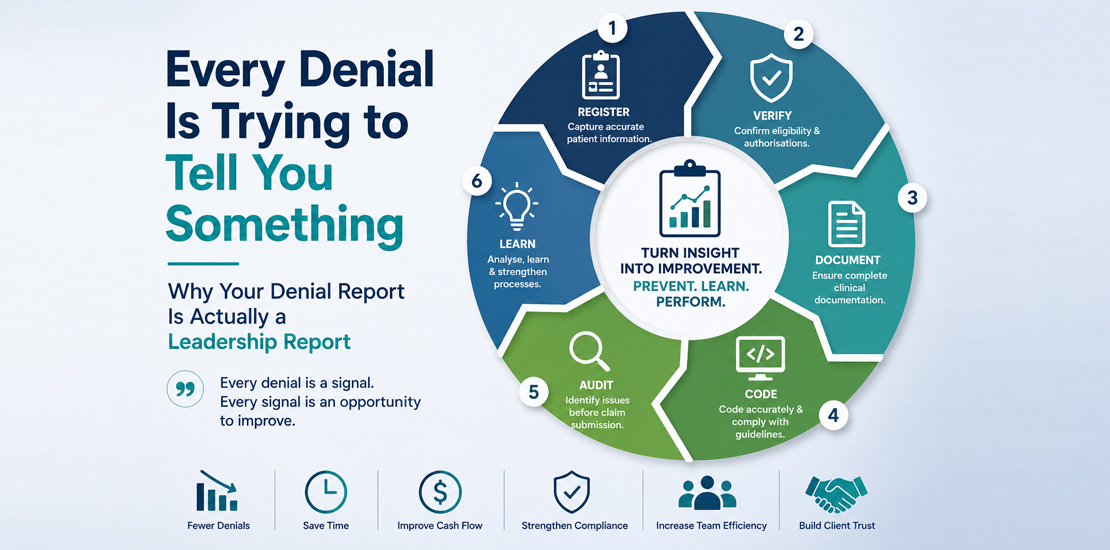
Why Your Denial Report Is Actually a Leadership Report
Every organisation receives denial reports.
Most organisations look at the numbers.
The best organisations look for the story.
A denial isn’t simply an unpaid claim.
It is evidence that something, somewhere, didn’t happen as it should have.
- Perhaps eligibility wasn’t verified.
- Perhaps documentation lacked the necessary detail.
- Perhaps coding wasn’t aligned with payer guidelines.
- Perhaps authorisation wasn’t obtained.
The denial appears at the end of the revenue cycle.
The mistake almost never begins there.
That is why high-performing Healthcare Revenue Cycle Management (RCM) organisations don’t ask:
“How many claims were denied?”
They ask a far more valuable question.
“What is this denial trying to teach us?”
That single shift in thinking transforms denial management from a reactive activity into a strategic advantage.
The Most Expensive Mistake Is Not the Denial
Many organisations believe a denial becomes expensive when reimbursement is delayed.
The cost begins much earlier.
Every preventable denial creates work that should never have existed.
- Someone investigates the issue.
- Someone corrects the documentation.
- Someone reviews coding.
- Someone communicates with stakeholders.
- Someone resubmits the claim.
- Someone follows up until payment is received.
By the time the claim is reimbursed, the organisation has invested far more time, effort and operational cost than necessary.
Denials don’t simply delay revenue.
They consume capacity.
Every hour spent correcting yesterday’s work is an hour that cannot be invested in creating new value.
Operational excellence isn’t about recovering denied claims.
It is about preventing unnecessary work in the first place.
Every Denial Has a Beginning
One of the most common misconceptions in Healthcare RCM is that denial management belongs to the Accounts Receivable team.
It doesn’t.
Denials begin long before Accounts Receivable becomes involved.
- A missing insurance verification.
- Incomplete patient registration.
- Incorrect medical documentation.
- Coding inconsistencies.
- Authorisation gaps.
- Communication failures.
Every department influences the final outcome.
This is why denial management should never be viewed as an isolated operational function.
It is an organisational responsibility.
When one process fails, the entire revenue cycle feels the impact.
The Denial Prevention Loop
At MedConverge, we believe that the strongest denial strategy is prevention, not recovery.
That philosophy is reflected in our Denial Prevention Loop, a continuous improvement model designed to reduce repeat errors and strengthen operational performance.
Register
Capture complete and accurate patient information from the outset.
Good outcomes begin with good data.
Verify
Confirm eligibility, payer requirements and authorisations before services progress.
Verification prevents avoidable surprises.
Document
Clinical documentation should tell the complete patient story.
Incomplete documentation creates uncertainty.
Uncertainty creates denials.
Code
Coding is more than assigning the correct codes.
It requires interpretation, accuracy and compliance.
Audit
Quality assurance should identify risks before submission—not after reimbursement has been delayed.
Learn
Every denial should produce one question:
“What process allowed this to happen?”
Learning turns operational mistakes into organisational improvement.
That is where real progress begins.
Denial Reports Reveal More Than Operational Data
Many organisations review denial percentages every month.
Few examine what those percentages actually reveal.
A denial report often answers questions leaders haven’t thought to ask.
- Which departments require additional training?
- Which payer policies create recurring challenges?
- Where are communication gaps occurring?
- Which process changes have improved performance?
- Where is accountability unclear?
Viewed correctly, denial reports become organisational diagnostics.
They highlight where systems need strengthening; not where people need blaming.
The Difference Between Blame and Accountability
There is a significant difference between identifying responsibility and assigning blame.
- Blame focuses on individuals.
- Accountability focuses on processes.
- Blame discourages reporting.
- Accountability encourages learning.
When employees fear criticism, mistakes are hidden.
When organisations encourage transparency, problems are identified earlier and solved more effectively.
The strongest operational cultures don’t ask:
“Who made this mistake?”
They ask:
“Why did our process allow this mistake to happen?”
That question creates continuous improvement.
Leadership Determines Denial Rates More Than Technology
Healthcare organisations continue investing in automation, Artificial Intelligence and analytics.
These investments matter.
But technology alone does not reduce denials.
Leadership does.
Leaders determine:
- Whether quality is prioritised over speed.
- Whether training is continuous or occasional.
- Whether audits identify trends or simply record findings.
- Whether employees feel comfortable escalating concerns before they become operational failures.
Technology supports operational excellence.
Leadership creates it.
Every Denial Is an Investment Opportunity
That may sound counterintuitive.
But organisations that systematically analyse denial patterns gain something incredibly valuable.
Operational intelligence.
Every recurring denial highlights an opportunity to:
- Improve documentation.
- Strengthen training.
- Refine workflows.
- Clarify accountability.
- Enhance quality assurance.
- Improve client outcomes.
When viewed this way, denials become one of the most valuable sources of business insight available to an RCM organisation.
Ignoring them means ignoring opportunities for improvement.
Final Thoughts
Denials will always exist.
Healthcare is too complex for perfection.
But repeated denials should never become accepted as routine.
Every denied claim carries information.
Every trend reveals a process.
Every process creates an opportunity.
The organisations that consistently outperform others are not those that eliminate every denial.
They are the ones that learn faster than everyone else.
Because operational excellence isn’t defined by how effectively you recover from mistakes.
It is defined by how consistently you prevent the same mistake from happening twice.