
- September 25, 2026
- Posted by: medconverge
- Category: RCM
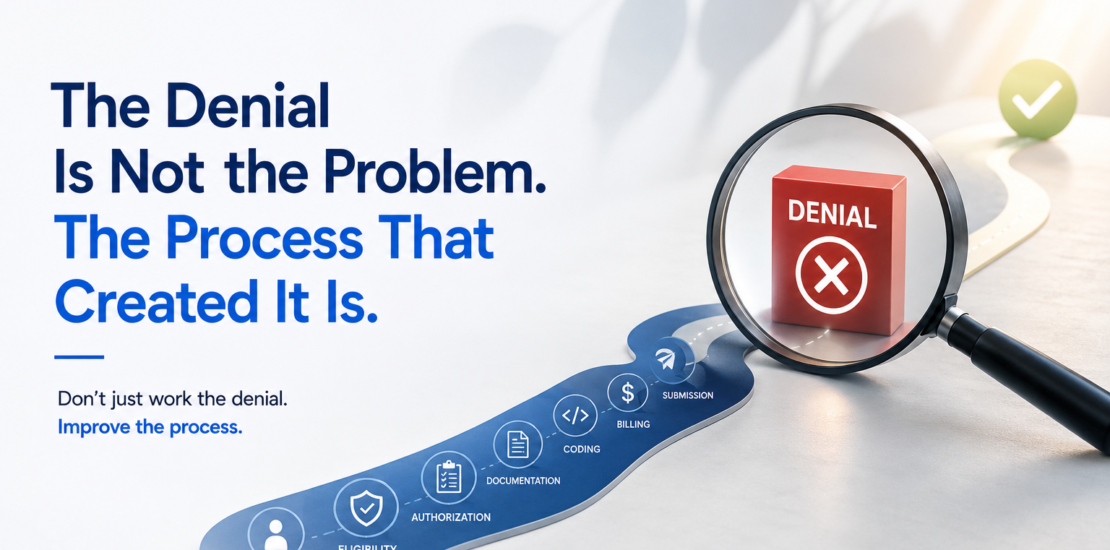
The Denial Is Not the Problem. The Process That Created It Is.
A denied claim attracts attention quickly.
Someone reviews it.
Someone identifies the reason.
Someone corrects or appeals it.
Someone follows up.
Eventually, the claim may get paid.
And everyone moves on.
That is when a different question needs to be asked:
Are we managing denials, or are we managing the process that creates them?
A denial is an outcome.
A denial is usually the visible end of a much longer chain.
Something may have happened during:
- Registration
- Eligibility verification
- Authorization
- Documentation
- Coding
- Charge capture
- Claim creation
- Submission
- Payer processing
By the time the denial appears, the original process failure may be several steps behind it.
That is why simply working the denial queue can become reactive.
Correction Is Not Prevention
Suppose a claim is denied because required information is missing.
Correction means:
- Find the information.
- Correct the claim.
- Resubmit it.
Prevention means asking:
- Why was the information missing?
- Was it available?
- Was the responsible team aware of the requirement?
- Was there a system validation?
- Did the SOP address the exception?
- Was the issue concentrated around a particular payer or service?
The first approach restores the individual claim.
The Five-Why Approach
A simple root-cause exercise can reveal more than the denial code itself.
Why 1: Why was the claim denied?
→ Required information was missing.
Why 2: Why was the information missing?
→ It wasn’t captured before submission.
Why 3: Why wasn’t it captured?
→ The workflow did not contain a mandatory validation step.
Why 4: Why wasn’t there a validation step?
→ The payer requirement was treated as an exception rather than a standard control.
Why 5: Why did that happen?
→ The process documentation wasn’t updated when the requirement changed.
Now the issue looks very different.
The denial wasn’t simply a billing error.
What Should RCM Leaders Look For?
A denial dashboard shouldn’t only answer:
“How many denials did we receive?”
It should also answer:
- Which reasons repeat?
- Which payers contribute most?
- Which departments create the most issues?
- Which denials are preventable?
- Which errors are increasing?
- How much rework is being generated?
- How long does resolution take?
- Are corrective actions actually reducing recurrence?
That changes denial management from a queue-management exercise into a process-improvement discipline.
Not Every Denial Is Preventable
This distinction matters.
Some denials may result from:
- Legitimate coverage limitations
- Payer decisions
- Policy restrictions
- Clinical circumstances
- Documentation limitations
- External factors
The objective isn’t to claim that every denial can be eliminated.
The objective is to identify the avoidable portion.
That is where process improvement creates value.
The Cost Goes Beyond the Claim
A recurring denial creates more than a financial issue.
It creates:
If ten people repeatedly spend time correcting the same avoidable issue, the organisation is effectively paying for a process failure.
And that cost may never appear clearly on a traditional denial report.
Build the Feedback Loop
A mature RCM operation should have a continuous loop:
Without the final steps, denial management becomes repetitive.
The team gets better at fixing the same problem rather than preventing it.
The Question That Changes Everything
Instead of asking:
“How do we reduce our denial rate?”
Ask:
That question moves the organisation from reaction to prevention.
Final Thought
A denial is important.
But a recurring denial is a message.
It is telling you that somewhere in the process, something isn’t working as intended.
That is where real RCM improvement begins.
Follow MedConverge for practical insights into healthcare revenue cycle management and process excellence.