
- September 21, 2026
- Posted by: medconverge
- Category: RCM
That creates an obvious opportunity: less time spent on repetitive work and more time spent on higher-value activities.
But there is another question that healthcare organisations need to consider:
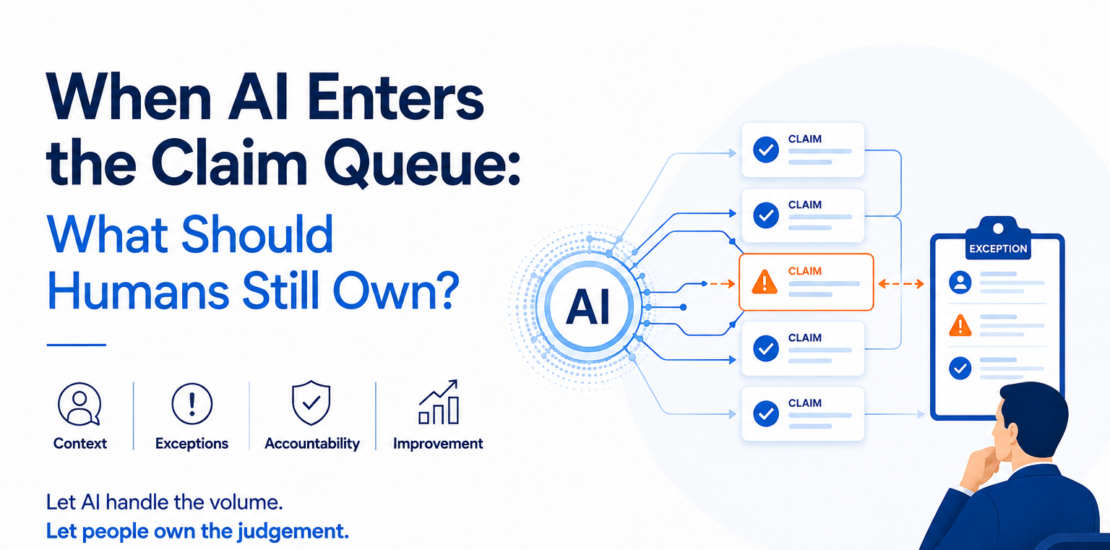
When AI enters the claim queue, what should humans still own?
The answer matters because a healthcare claim is more than a set of data points.
A claim can involve clinical documentation, coding decisions, payer requirements, financial implications and circumstances that may not be obvious from the data alone.
AI can identify that something looks unusual.
A person may still need to determine why it is unusual and what should happen next.
Where AI Can Help in RCM
There are many parts of the revenue cycle where AI and automation can create real value.
For example, technology can help teams:
- Identify unusual claim patterns
- Prioritise accounts for review
- Detect potential documentation gaps
- Identify recurring denial patterns
- Support claim-scrubbing activities
- Analyse historical payment behaviour
- Highlight accounts that need attention
- Reduce repetitive manual checks
The biggest advantage is scale.
A person can review only so many claims in a day. An automated system can analyse much larger volumes of information and identify patterns that might otherwise take considerable time to find.
That can change the role of the RCM professional.
Instead of spending most of the day searching for problems, teams can spend more time investigating the problems that actually require their expertise.
Finding a problem is not the same as understanding it.
A Flag Does Not Always Mean an Error
Imagine an AI system flags a claim because it does not match the usual pattern.
That does not automatically mean the claim is wrong.
There could be additional documentation.
The payer may have a specific requirement.
The patient’s circumstances may be different from the cases the system has seen before.
Or the claim may simply be a legitimate exception.
This is where human judgement becomes important.
An experienced RCM professional may ask:
- Why was this claim flagged?
- Is there information the system did not consider?
- Is this actually an error or simply an exception?
- What could happen if the recommendation is acted upon?
These are not questions that should be answered simply because an algorithm produced a score or recommendation.
They require context.
Four Things Humans Should Continue to Own
As AI takes on more routine RCM activities, four areas are likely to remain particularly important for human professionals.
1. Context
AI is very good at analysing information.
People are still needed to understand that information within the context of a specific case.
A claim is connected to a patient encounter, documentation, coding, payer requirements and the broader revenue-cycle process.
Two claims can look similar in a dataset and still require different decisions.
Technology can bring a claim to someone’s attention.
Human expertise helps determine what the claim actually means.
2. Exceptions
Routine work is generally easier to automate.
Exceptions are different.
They often require investigation, experience and an understanding of how different parts of the revenue cycle interact.
As technology handles more predictable transactions, exception management could become an increasingly important skill for RCM professionals.
The future RCM professional may spend less time processing routine cases and more time answering:
That is a valuable shift.
3. Accountability
This is an area where organisations should be especially clear.
If an AI recommendation contributes to an incorrect action, someone still needs to be accountable for understanding what happened.
Questions may include:
- What information was considered?
- Why was the recommendation accepted?
- Who reviewed the case?
- Was the correct escalation followed?
- What corrective action was taken?
- How can a similar issue be prevented?
AI can support a decision.
It should not make accountability disappear.
Clear human ownership is therefore an important part of responsible AI adoption.
4. Improvement
AI can reveal that a problem is happening repeatedly.
The next question should be:
Suppose the same denial appears again and again.
Reviewing more claims may help manage the immediate problem. But it may not solve the underlying cause.
The root cause could be a documentation issue, a training gap, a workflow problem, a payer-policy misunderstanding or a system configuration issue.
The real opportunity is to use the information generated by technology to improve the process itself.
That is where RCM expertise continues to make a difference.
The RCM Skillset Is Changing
AI adoption does not mean traditional RCM knowledge becomes irrelevant.
Medical terminology, coding and billing knowledge, payer understanding, documentation requirements and revenue-cycle expertise will remain important.
But the skills surrounding them are changing.
Future-facing RCM teams will increasingly benefit from capabilities such as:
- Analytical thinking
- Data interpretation
- Technology and AI literacy
- Exception management
- Root-cause analysis
- Critical thinking
- Decision-making
- Process improvement
- Communication
The most valuable professional may not simply be the person who can process the highest number of claims.
It may be the person who can look at the information produced by technology, recognise when something does not make sense, investigate the reason and recommend what should happen next.
The Risk of Trusting Automation Too Much
AI can improve efficiency, but there is a risk that should not be overlooked.
When a system provides an answer quickly, people can become less likely to question it.
That can be dangerous in any process where decisions have financial, operational or compliance implications.
The concern is not only that AI could make a mistake.
It is that a mistake could be accepted more quickly because it came from an automated system.
That is why successful AI adoption requires more than implementing a tool.
Organisations also need appropriate human oversight, clear escalation processes, quality controls and regular evaluation of outcomes.
The goal should not be to remove people from every part of the process.
It should be to put people where their judgement adds the most value.
From Automation to Better RCM
The strongest opportunity may not be complete automation.
It may be better collaboration between technology and people.
AI can handle high volumes of information and repetitive activities.
It can identify patterns and prioritise areas that deserve attention.
RCM professionals can investigate exceptions, apply context, make decisions and address the underlying causes of recurring problems.
This creates a practical model for AI-enabled RCM:
Investigate the unusual.
Question the recommendation when necessary.
Improve the process behind the problem.
The objective should therefore not be to ask:
“How much of RCM can we automate?”
A better question is:
“Where should AI act, where should it assist, and where should humans decide?”
That distinction can influence not only productivity, but also quality and accountability.
What This Means for Healthcare Organisations
AI adoption should not be treated simply as a technology purchase.
It is also a change in how work is organised.
Organisations need to consider how technology will affect workflows, employee capabilities, quality checks and decision-making responsibilities.
The organisations that gain the most from AI may not necessarily be those that automate the largest number of tasks.
They may be the ones that understand where automation creates value and where human expertise remains essential.
That means investing not only in technology, but also in people who know how to use it effectively.
Final Thought
AI is likely to change the way healthcare RCM teams work.
Some repetitive activities will become faster.
Some manual reviews will be reduced.
Some decisions will be supported by increasingly sophisticated systems.
But healthcare revenue cycle management will still require people who can understand context, investigate exceptions, take responsibility and improve the processes behind recurring problems.
The future is not about choosing between people and technology.
It is about using each where they create the most value.
Let people own the judgement.
Because the real promise of AI in healthcare RCM is not simply doing more work with fewer people.
It is giving people more time to focus on the work that technology cannot and should not own.
MedConverge brings practical perspectives on healthcare RCM, technology, workforce capability and process excellence to help organisations navigate the changing healthcare landscape.