
- January 31, 2026
- Posted by: medconverge
- Category: RCM
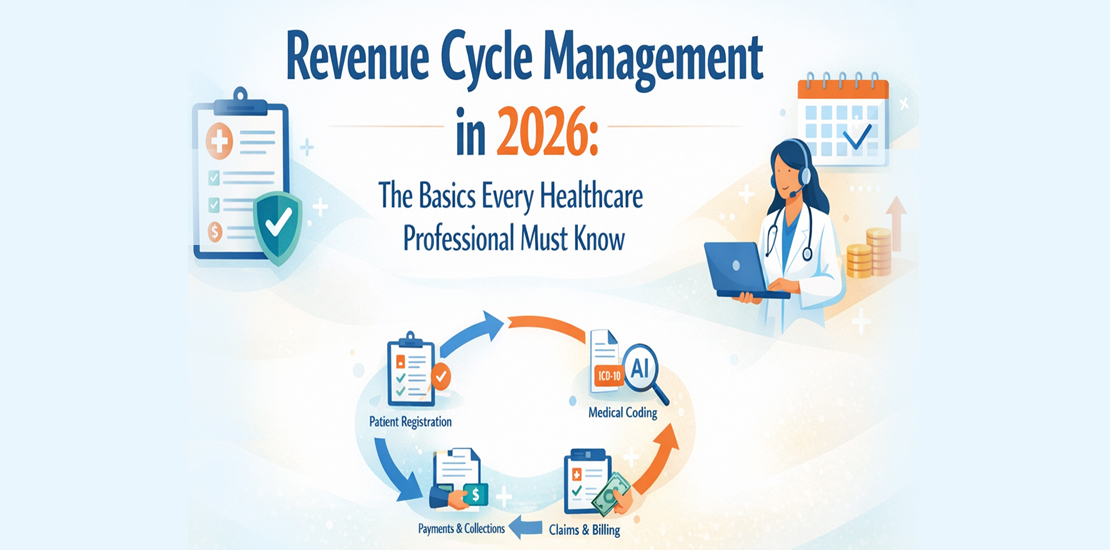
Revenue Cycle Management (RCM) is no longer just a back-office function—it is the financial backbone of modern healthcare. In 2026, with tighter regulations, digital-first care delivery, and rising patient expectations, understanding the basics of RCM is essential for providers, billing professionals, and healthcare leaders alike.
This guide breaks down Revenue Cycle Management in a clear, practical way—perfect for anyone looking to understand how healthcare organisations get paid efficiently and compliantly.
What Is Revenue Cycle Management (RCM)?
Revenue Cycle Management refers to the end-to-end process healthcare organisations use to track patient care episodes, from the first appointment to the final payment.
In simple terms, RCM ensures that:
- Services provided are accurately documented
- Claims are properly coded and submitted
- Payments are collected on time
- Revenue leakage is minimised
In 2026, RCM combines people, processes, and technology to keep healthcare financially sustainable.
The Core Stages of the RCM Process
- Patient Access & Registration
The revenue cycle starts before the patient sees a provider. Accurate demographic capture, insurance verification, and eligibility checks prevent downstream claim denials.
2026 focus: Real-time insurance verification and automated pre-authorizations. - Medical Documentation
Providers document diagnoses, procedures, and services delivered during patient encounters. Clear, complete documentation is critical for compliance and reimbursement.
2026 focus: AI-assisted clinical documentation and EHR-integrated prompts. - Medical Coding
Medical coders translate clinical documentation into standardised codes (ICD-10, CPT, HCPCS). Coding accuracy directly impacts revenue and audit risk.
2026 focus: Computer-assisted coding (CAC) with human validation. - Charge Capture
All billable services must be captured and aligned with documentation. Missed charges lead to lost revenue.
2026 focus: Automated charge capture integrated with clinical workflows. - Claims Submission
Clean claims are submitted electronically to payers. Even minor errors can delay or deny payment.
2026 focus: First-pass claim acceptance driven by AI claim scrubbing. - Payment Posting
Payments from insurers and patients are posted, reconciled, and matched against claims.
2026 focus: Automated payment posting and denial analytics. - Denial Management
Denied or underpaid claims are analysed, corrected, and resubmitted. Effective denial management protects revenue.
2026 focus: Predictive denial prevention rather than reactive appeals. - Patient Billing & Collections
Patients now bear higher financial responsibility. Transparent, patient-friendly billing is essential.
2026 focus: Digital statements, flexible payment plans, and price transparency.
Why RCM Looks Different in 2026
Revenue Cycle Management has evolved rapidly due to:
- Value-based care models
- Telehealth and hybrid care delivery
- Stricter compliance requirements from the Centres for Medicare & Medicaid Services
- AI-driven automation
- Increased patient financial responsibility
RCM today is not just about getting paid—it’s about data accuracy, compliance, patient trust, and operational efficiency.
Key Skills Needed for RCM Professionals in 2026
To succeed in modern RCM roles, professionals must understand:
- Medical billing and coding fundamentals
- Healthcare regulations and compliance
- Revenue analytics and KPIs
- Automation and RCM software tools
- Patient-centric financial communication
RCM is now one of the fastest-growing non-clinical career paths in healthcare.
Final Thoughts
The basics of Revenue Cycle Management remain rooted in accurate documentation, coding, billing, and collections—but how these tasks are performed has transformed in 2026.
Organisations that invest in strong RCM foundations, skilled professionals, and smart technology are better positioned to:
- Improve cash flow
- Reduce denials
- Stay compliant
- Enhance patient experience
Whether you’re new to healthcare or looking to strengthen your RCM knowledge, understanding these fundamentals is the first step toward long-term success.
Want more insights on RCM careers, trends, and best practices? Follow us for practical healthcare finance knowledge tailored for today’s industry.