
- September 29, 2026
- Posted by: medconverge
- Categories: Medical Billing, RCM
Why a Personal Skill Audit Matters
Career development is often treated as a long-term exercise.
Courses. Certifications. Training programs. Promotion plans.
All of these have value.
But there is a much simpler exercise that can take less than ten minutes:
A personal skill audit.
The purpose isn’t to create another checklist.
It is to pause and ask a more important question:
What can I do well today and what will I need to do well tomorrow?
Understanding the Changing Healthcare RCM Role
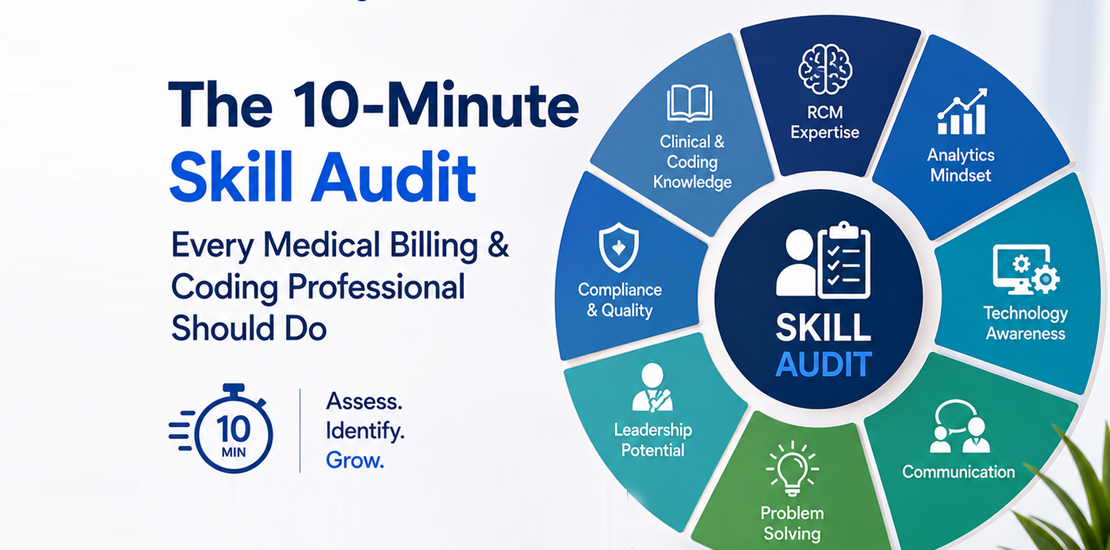
Healthcare RCM is changing. Traditional billing and coding knowledge remains fundamental, but the role around it is becoming broader. Analytics, automation, compliance, technology, problem-solving and communication are increasingly becoming part of how revenue cycle work is performed and managed.
That means being good at today’s job is not necessarily the same as being ready for tomorrow’s role.
And that is where a personal skill audit becomes useful.
Start With the Foundation
Start with the foundation.
How confident are you in medical terminology, anatomy and physiology, coding fundamentals, billing concepts, insurance terminology and the claims lifecycle?
Can you explain denial management and AR processes beyond simply following the steps?
Give yourself a score from 1 to 5.
But be honest.
A skill audit only works if the score reflects your actual capability rather than the answer you would like to be true.
Examine Your Operational Performance
Then look beyond technical knowledge and examine how you perform operationally.
- How consistent is your accuracy?
- How reliable is your productivity?
- Do you understand turnaround-time expectations?
- How often is your work right the first time?
- Do you follow SOPs because you understand the process, or because you know you are expected to follow them?
And perhaps most importantly:
Do you understand why the process works the way it does?
That last question becomes increasingly important as you move into more senior roles.
A strong professional doesn’t just know which button to press.
They understand what happens before the button is pressed, what happens afterwards, and what could go wrong along the way.
Assess Your Analytical Thinking
The next area to examine is analytical thinking.
You don’t need to be a data scientist.
But can you look at a report and identify a problem?
Can you explain why productivity changed?
Can you identify a recurring denial trend?
Can you compare payer performance?
Can you recognise an unusual pattern?
Can you move from “What happened?” to “Why did it happen?”
If the answer is no, analytics may be one of the most valuable areas for your development.
Build Technology Awareness
Technology awareness deserves the same attention.
You don’t need to become a programmer to remain relevant in an increasingly technology-enabled RCM environment.
But you should understand:
- what automation can do
- where AI can assist
- what a dashboard is actually telling you
- why data quality matters
- where automated systems can make mistakes
The goal isn’t to become technical for the sake of being technical.
It is to become comfortable enough with technology to understand how it can change the work you perform.
Develop Communication Skills
Then comes a capability that becomes more important with almost every career step:
Communication.
- Can you explain a complicated issue clearly?
- Can you write a professional escalation?
- Can you speak confidently with a client or stakeholder?
- Can you coach another employee?
- Can you explain a process problem without immediately blaming the person involved?
As responsibility increases, technical knowledge alone becomes insufficient.
The ability to communicate what you know becomes part of the value you bring.
Test Your Problem-Solving Ability
Problem-solving is another useful test.
When something goes wrong, what is your natural response?
Do you fix the issue and move on?
Or do you fix it, understand why it happened and consider how the recurrence can be reduced?
The first approach solves today’s problem.
The second develops you into someone capable of improving the operation.
That distinction is often what separates task execution from professional growth.
Divide Your Skills Into Three Categories
Once you have assessed yourself, don’t try to improve everything at once.
Divide your capabilities into three simple categories:
- Strong — skills you consistently demonstrate.
- Developing — skills you can perform but need greater confidence or depth in.
- Priority — capabilities that could materially influence your next career step.
Then choose one or two priority areas.
Not ten.
Career development often fails because people create ambitious development plans that are impossible to sustain.
Focused improvement is more powerful.
Build Your Personal Skill Stack
This is where the idea of a personal skill stack becomes useful.
A future-ready RCM professional may gradually build capability across several dimensions:
Healthcare knowledge + RCM expertise + Analytics + Technology awareness + Communication + Problem-solving + Leadership
You don’t need to master all of these immediately.
But you should understand where your current strengths sit and which capability would make the biggest difference to your next step.
Compare Yourself With the Next Role
There is another question that can make this exercise even more practical:
What does the person one level above me do that I cannot confidently do today?
If you’re an associate, look at the SME.
If you’re an SME, look at the team lead.
If you’re a team lead, look at the manager.
Don’t focus only on their title.
Look at their capabilities.
- What decisions can they make that you cannot?
- What reports can they interpret?
- What problems can they solve?
- What conversations can they handle?
- What level of ownership do they demonstrate?
Those differences often reveal your development priorities more clearly than a generic career plan ever will.
Don’t Wait for a Promotion
And there is an important mindset shift here.
Don’t wait for a promotion to start developing for the next role.
Start building the capability before the opportunity appears.
Because when the opportunity comes, the question shouldn’t be:
“Can I learn this role?”
It should be:
“I’m already doing much of this. Now I’m ready to take the responsibility.”
Your Skill Stack Matters More Than Your Resume Alone
Your resume tells people what you have done.
Your skill stack tells them what you can do next.
Take Ten Minutes This Month
So take ten minutes this month.
Be honest about where you are.
Identify one capability that matters for where you want to go.
Then work on it consistently.
Because your next career opportunity may not require more experience.
It may require a skill you haven’t started building yet.
Follow MedConverge for practical perspectives on healthcare careers, RCM, technology and professional development.