
- August 11, 2026
- Posted by: medconverge
- Category: Medical Billing
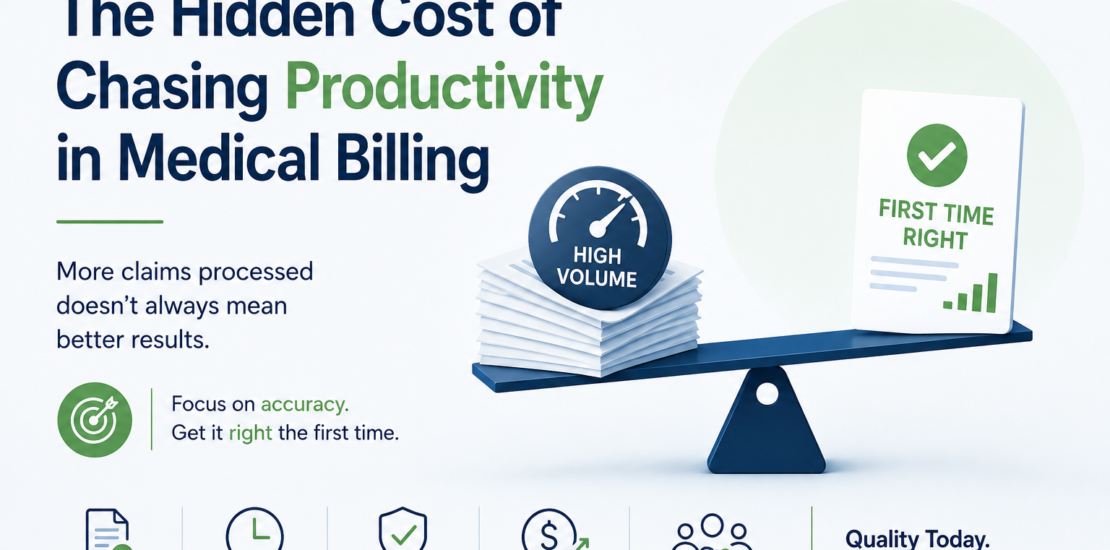
The Hidden Cost of Chasing Productivity in Medical Billing
Everyone celebrates productivity.
Dashboards are reviewed.
Turnaround times are monitored.
Daily volumes are compared.
Teams are recognised for processing more claims than the previous day.
On paper, everything looks impressive.
But here’s the uncomfortable question very few organisations ask:
How many of those claims were right the first time?
Because productivity means very little when accuracy is sacrificed to achieve it.
A claim submitted in minutes may still return days later as a denial.
A coding oversight that takes seconds to make can take hours to investigate, correct, resubmit and follow through to reimbursement.
The numbers may suggest efficiency.
The reality often tells a very different story.
The highest-performing Healthcare Revenue Cycle Management (RCM) organisations have already recognised this.
They don’t measure success by how much work leaves the desk.
They measure how confidently that work reaches payment the first time.
That difference changes everything.
The Productivity Illusion
For years, many organisations have rewarded volume.
More claims processed.
More accounts worked.
More tasks completed.
While these metrics have their place, they tell only part of the story.
A team processing 800 claims with a high denial rate is not outperforming a team processing 650 clean claims.
The first team appears more productive.
The second is creating more value.
This is where many organisations unknowingly create what I call the Productivity Illusion; a situation where activity is mistaken for effectiveness.
The result is predictable:
- Rising rework
- Increasing operational costs
- Delayed reimbursements
- Lower client confidence
- Frustrated employees spending more time correcting yesterday’s work than completing today’s
Real productivity isn’t about working faster.
It’s about reducing the need to do the same work twice.
Every Error Has a Cost That Isn’t Visible on a Dashboard
One incorrect modifier.
One missed eligibility check.
One inaccurate patient demographic.
One overlooked documentation requirement.
Individually, they seem insignificant.
Collectively, they become one of the biggest hidden costs in Healthcare RCM.
The financial impact extends well beyond a denied claim.
Each error creates a chain reaction:
- Additional investigation
- Corrective action
- Resubmission
- Follow-up
- Delayed cash flow
- Increased administrative effort
- Reduced team capacity
The claim is eventually paid.
But the organisation has already spent considerably more time and resources than it should have.
Operational waste rarely arrives as one major failure.
It accumulates through hundreds of small, preventable mistakes.
The First-Time-Right Framework
At MedConverge, operational excellence begins long before a claim is submitted.
Every successful outcome depends on disciplined execution throughout the revenue cycle.
Our First-Time-Right Framework is built around six interconnected stages:
- Capture: Collect complete and accurate patient and insurance information from the outset.
- Verify: Confirm eligibility, authorisations and payer-specific requirements before work progresses.
- Validate: Review coding, documentation and charge capture against current guidelines and internal quality standards.
- Review: Apply structured quality checks before submission, not after a denial occurs.
- Submit: Send claims with confidence, knowing that quality has already been built into the process.
- Learn: Analyse denials, identify trends and continuously improve the system rather than simply correcting individual claims.
When these six stages become everyday habits, accuracy stops being an inspection activity and becomes part of the organisation’s culture.
Technology Can Accelerate Work. It Cannot Replace Judgement.
Artificial Intelligence is transforming Healthcare RCM.
Automation can identify inconsistencies.
Predictive tools can highlight potential denials.
Workflow platforms reduce repetitive manual effort.
These innovations matter.
But technology cannot determine whether clinical intent has been documented appropriately.
It cannot replace experienced professionals who understand payer expectations, interpret complex scenarios or recognise when something simply “doesn’t look right.”
Technology improves speed.
People protect quality.
The organisations that will lead the future of Healthcare RCM are those that invest in both.
Quality Is a Leadership Decision
Many discussions around quality focus on frontline teams.
In reality, quality begins with leadership.
Leaders decide what success looks like.
If dashboards celebrate volume above all else, employees naturally prioritise speed.
If leaders recognise first-pass accuracy, thoughtful problem-solving and continuous improvement, the culture changes. People stop chasing numbers.
They start protecting outcomes.
Operational excellence is never accidental. It is created by the standards leaders choose to reward.
The Organisations That Win Think Differently
High-performing RCM organisations ask different questions.
Instead of asking:
“How many claims did we process today?”
They ask:
- How many were accepted the first time?
- Which errors were preventable?
- What did we learn from today’s denials?
- Which process created the greatest operational risk?
- How do we prevent tomorrow’s rework?
Those questions produce stronger organisations.
Final Thoughts
Healthcare Revenue Cycle Management isn’t a race to process the highest number of claims.
It’s a discipline built on precision, accountability and continuous improvement.
Every clean claim strengthens cash flow.
Every preventable error avoided protects both revenue and reputation.
Every lesson learned from today’s work creates a stronger organisation tomorrow.
Organisations that consistently outperform their competitors aren’t necessarily the fastest. They’re the ones that make quality a habit rather than an inspection.
Because operational excellence isn’t measured by how quickly work leaves your desk. It’s measured by how confidently it reaches its destination the first time.