
- October 4, 2026
- Posted by: medconverge
- Categories: Medical Coding, RCM
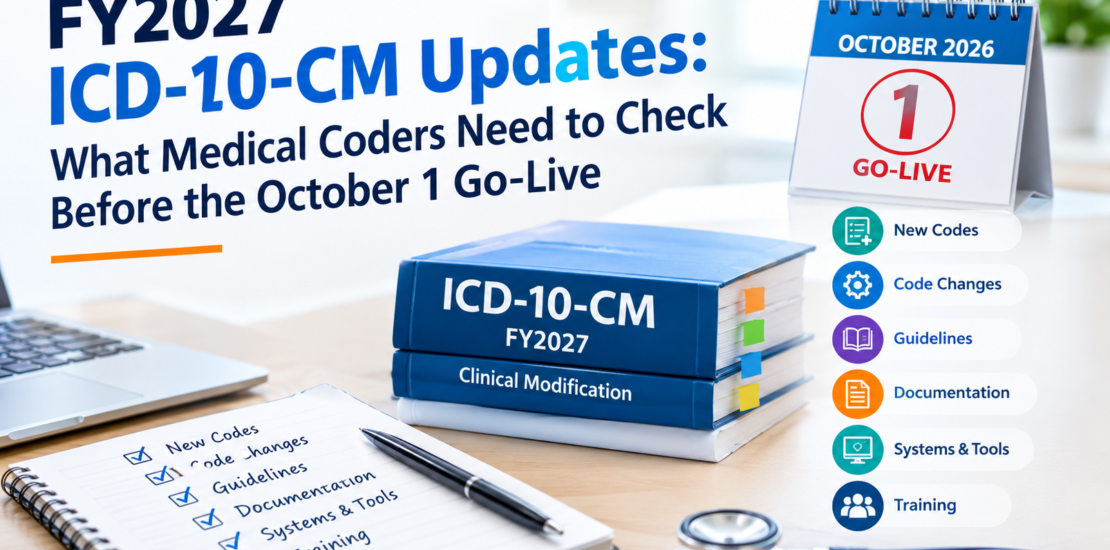
FY2027 ICD-10-CM Updates: What Medical Coders Need to Check
For medical coding teams, October 1 is not just another date on the calendar.
It marks the beginning of a new ICD-10-CM fiscal-year code set and, with it, the need to make sure everyday coding work reflects the latest requirements.
The obvious question is:
Have the new codes been downloaded?
The more useful question is:
Is the entire coding workflow ready for the change?
A code-set update affects more than the reference material sitting on a coder’s desk. It can influence software, internal guidance, quality checks, training and the way certain cases are reviewed.
Here are the areas coding teams should look at before settling into the new coding year.
1. Start with the official code set
The first step is making sure the team is working from the current FY2027 ICD-10-CM files and official guidance.
Old reference material can create confusion when a coder encounters a new, revised, deleted or otherwise changed code.
The source matters too. Teams should rely on authorised coding references rather than informal summaries circulating among colleagues or online.
A five-minute shortcut at the beginning can create hours of correction later.
2. Review the changes that actually affect your work
Not every change will have the same relevance to every coding team.
A coder working extensively with one speciality may need to pay close attention to a completely different group of updates than someone supporting another area of healthcare.
The practical approach is to identify the changes that are relevant to the cases your team handles regularly.
That gives training a purpose.
Instead of asking coders to memorise an enormous list of changes, focus learning on the areas they are most likely to encounter.
3. Check coding references and internal material
Many teams use more than one reference source during their work.
Code books, internal process documents, quick-reference sheets, training presentations, QA forms and workflow instructions may all contain coding information.
If one of these remains outdated, the team can receive conflicting instructions.
A simple review can help identify:
- Old code references
- Outdated examples
- Previous-year screenshots
- Incorrect internal instructions
- Obsolete quick-reference material
The objective is consistency.
The coder should not have to decide which internal document is still valid.
4. Review encoder and software configuration
Technology supports coding, but it does not remove the need for human review.
Before the updated code year becomes routine, teams should confirm that their encoder, coding applications and related systems reflect the applicable changes.
This is also a good opportunity to check whether internal shortcuts, templates or system-based prompts need attention.
A software update that nobody verifies is not a complete implementation.
5. Refresh the QA checklist
Quality teams should not wait for errors to appear before updating their review process.
If a coding change affects an area that is already part of routine auditing, the relevant QA criteria should be reviewed.
Auditors and coders should be working from the same understanding of the current requirements.
This also makes early post-implementation monitoring more useful because the team knows what it is watching for.
6. Train for relevance, not volume
Annual updates do not mean every coder needs the same training session.
A better approach is to connect learning with actual work.
For example, a team can use:
- Short update sessions
- Relevant case examples
- Scenario-based discussions
- Focused quizzes
- Targeted QA reviews
Practical examples often make a change easier to understand than a long list of code descriptions.
The goal is not simply to tell coders what changed.
It is to help them recognise when that change matters during real work.
7. Consider payer and workflow implications
Coding does not happen in isolation.
Healthcare organisations and RCM teams also work within payer-specific requirements and operational processes.
Where applicable, teams should review whether changes have implications for their existing workflows, documentation expectations or internal checks.
This is particularly important when a coding update intersects with other parts of the claim lifecycle.
8. Watch the first few weeks closely
The first month after an annual update can tell you a lot.
Look for patterns rather than isolated mistakes.
Are certain codes generating repeated questions?
Are the same errors appearing during QA?
Are particular specialities producing more corrections?
Are coders relying heavily on clarification?
These patterns can reveal where additional guidance is needed.
9. Create a 30-day review
A short post-implementation review gives the team a chance to step back and ask:
What worked?
Where did people struggle?
What errors appeared repeatedly?
What needs additional training?
Which internal references should be improved before the next update?
This turns the annual coding update into a learning cycle rather than a once-a-year administrative task.
The real goal of an ICD-10 update
Successful coding teams do not treat October 1 simply as a deadline.
They treat it as a transition.
The objective is not merely to know that something changed.
The objective is to make sure the change is reflected accurately in everyday work.
That requires the right references, updated systems, practical training, meaningful quality checks and attention to what happens after implementation.
A code-set update is complete only when the people, processes and tools supporting the work are ready for it.
MedConverge supports healthcare professionals who want to build practical knowledge across medical coding, billing and revenue cycle management.
Want to strengthen your coding fundamentals and stay prepared for changes in the coding environment? Explore MedConverge’s healthcare training programs.