
- September 26, 2026
- Posted by: medconverge
- Category: RCM
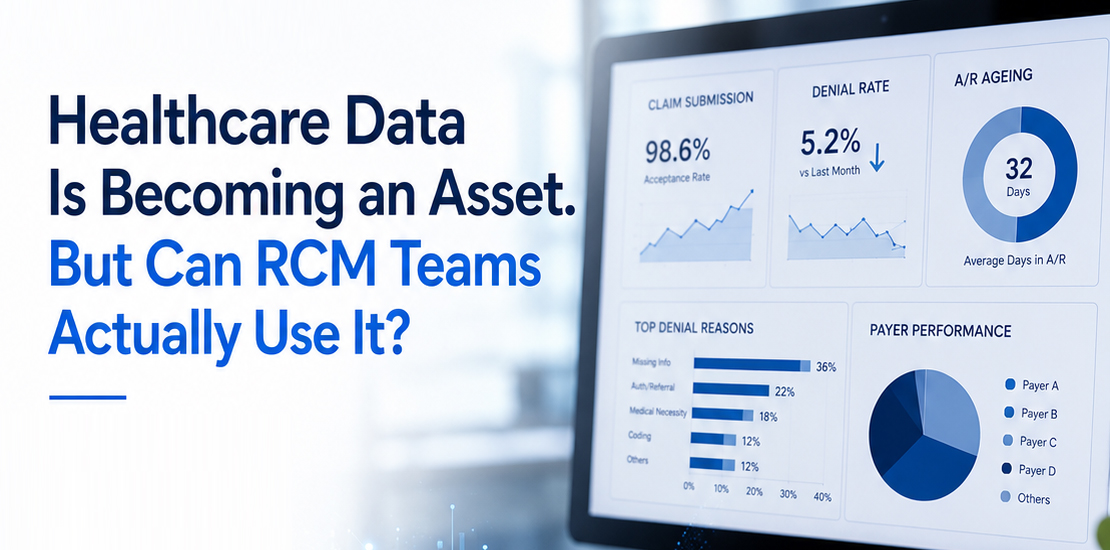
Healthcare Data Is Becoming an Asset. But Can RCM Teams Actually Use It?
Healthcare operations generate enormous amounts of data.
Claims. Payments. Denials. Accounts receivable. Productivity. Quality. Payer behaviour. Turnaround time. Rework.
Every transaction leaves a trail of information. Every process generates measurements. Every operational decision creates another data point.
But having data and being data-driven are two very different things.
The more important question for healthcare revenue cycle management is not how much data we have, but whether we can turn that data into better decisions.
This question is becoming increasingly relevant as healthcare moves deeper into digitalisation, analytics, interoperability and responsible AI. Across India’s healthcare ecosystem, the conversation is gradually shifting from simply digitising information to using that information more intelligently.
RCM has an opportunity to be part of that shift.
In reality, revenue cycle teams are already sitting on a significant operational data asset. Patient access generates information around registration accuracy, eligibility and authorisation. Coding produces data around accuracy, documentation and turnaround time. Claims provide visibility into submission, acceptance, rejection and payer responses. Denials reveal patterns by reason, payer, department, financial value and resolution time. AR provides another layer through ageing, outstanding balances, follow-up activity and collection outcomes.
The problem is rarely the absence of data.
The problem is that the data often remains fragmented across processes, systems and teams.
And even when it is brought together in a dashboard, another challenge emerges: organisations often confuse reporting with insight.
Consider a simple example.
An RCM leader may be told that the organisation experienced 1,200 denials during the month. That is data.
The next level of understanding might show that 35% of those denials came from three payer categories. That is information.
But the real value appears when the organisation discovers that one of those payer categories has a recurring documentation issue concentrated around a particular workflow or service.
That is an insight.
And the purpose of the insight is not to create a more sophisticated report.
It is to change something.
Perhaps the workflow needs to be redesigned. Perhaps a validation needs to be introduced. Perhaps the team needs additional training. Perhaps the technology needs a rule or edit. Perhaps the payer requirement needs to be incorporated into the operating process.
That is the point at which data becomes operational intelligence.
This distinction becomes even more important when looking at productivity.
Suppose an RCM team reports 95% productivity achievement. On the surface, that sounds like strong performance. But what if rework has increased at the same time? What if quality has declined? What if complex accounts are being moved elsewhere? What if unresolved exceptions are accumulating outside the productivity measurement?
The number may still be accurate.
But the conclusion drawn from it may be wrong.
This is why experienced RCM leaders need to look beyond individual KPIs and understand the relationship between them. Productivity cannot always be separated from quality. Denials cannot always be separated from upstream processes. AR ageing cannot always be separated from claim quality. Turnaround time cannot always be interpreted without understanding workload complexity.
A KPI without context can create the illusion of performance.
The value of analytics therefore lies not simply in producing more metrics, but in connecting them.
A good RCM dashboard should help a leader understand where work is accumulating, what is causing delays, which errors are repeating, where rework is increasing, which payer behaviours are changing and which processes require attention.
That creates an important distinction.
A dashboard that tells you what happened is primarily a reporting tool.
A dashboard that helps you understand why it happened becomes an analytical tool.
A dashboard that helps you anticipate what may happen next becomes a predictive tool.
And a system that helps you determine what should change becomes a management tool.
This is where the future of RCM analytics becomes particularly interesting.
Historical data can reveal patterns that may allow organisations to act earlier. If a payer consistently produces a particular denial pattern, could the risk be identified before submission? If a workflow repeatedly generates rework, could the process be investigated before productivity deteriorates? If a particular queue consistently approaches ageing thresholds, could resources be adjusted before the backlog becomes critical?
The objective is not to predict everything.
It is to move the organisation from reacting to problems to recognising patterns early enough to prevent them.
But there is an important prerequisite that is sometimes overlooked.
Data quality comes before analytics.
A sophisticated dashboard built on incomplete, inconsistent or incorrectly classified information does not create better decision-making. It can actually create greater confidence in the wrong conclusion.
Before asking, “What does the dashboard tell us?”, leaders should also ask:
“Can we trust the data behind the dashboard?”
That means understanding how data is captured, defined, classified, validated and connected across the revenue cycle.
It also means being careful about what the numbers do not tell us.
A rising denial rate may indicate a process problem, but it may also reflect a change in payer behaviour, service mix or documentation requirements. A fall in AR may indicate stronger collections, but it could also reflect changes in account volume. Higher productivity may represent genuine improvement, or it may be influenced by changes in work complexity.
Analytics does not eliminate the need for judgement.
It makes good judgement more informed.
This is perhaps where the role of the RCM leader is changing most significantly.
The traditional progression has been:
What happened?
Then:
Why did it happen?
The next question is:
What is likely to happen next?
But the most valuable question remains:
What should we do about it?
That final step is where business value is created.
An organisation can have a sophisticated analytics platform, dozens of dashboards and thousands of data points and remain operationally reactive if nobody converts those insights into decisions.
The future RCM leader therefore may not need to become a data scientist.
But they will increasingly need to become data-literate.
They need to understand what the numbers represent, question what they do not represent, recognise patterns, challenge assumptions and connect operational metrics back to business outcomes.
Most importantly, they need to know when a number is telling them to investigate the process behind it.
Because healthcare organisations don’t need more numbers simply for the sake of having more numbers.
They need better questions.
Better questions produce better analysis.
Better analysis supports better decisions.
And better decisions create better operations.
The value of RCM data isn’t in how much you collect.
It is in how much better you can operate because of it.
Follow MedConverge for practical perspectives on healthcare operations, RCM analytics, technology and process excellence.