
- August 26, 2026
- Posted by: medconverge
- Category: RCM
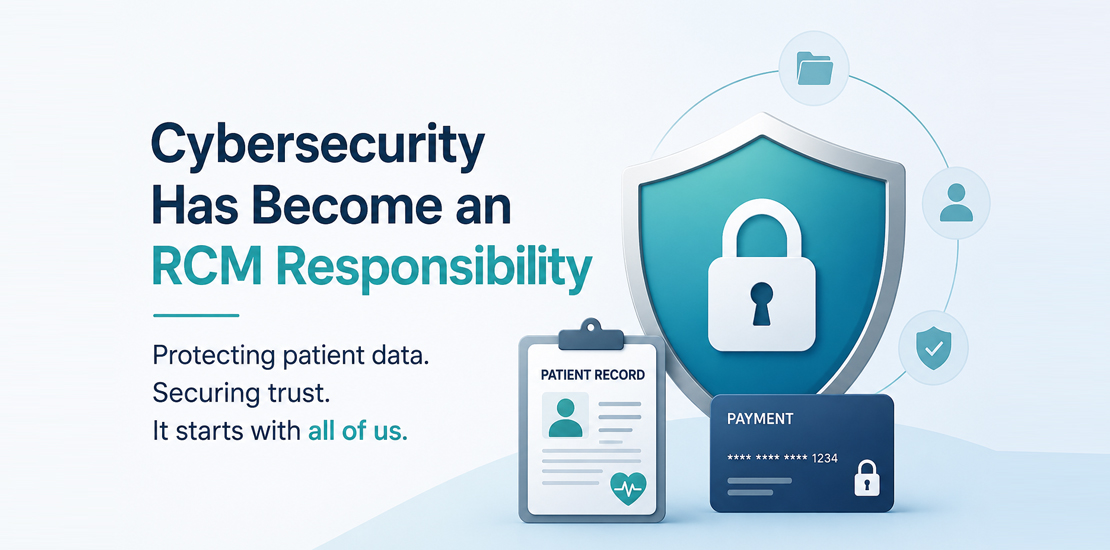
Cybersecurity in Healthcare RCM
Cybersecurity in Healthcare RCM is no longer just an IT responsibility. As RCM teams handle sensitive patient, financial, and insurance information every day, strong security practices, compliance, and employee awareness are essential to protecting data and maintaining trust.
There was a time when cybersecurity was seen as the IT department’s responsibility. If systems were running, passwords were managed, and antivirus software was up to date, most people believed their part was done.
That reality no longer exists.
Today, cybersecurity is everyone’s responsibility, and nowhere is that more evident than in Revenue Cycle Management (RCM).
Every day, RCM professionals handle information that is not only financially valuable but also deeply personal. Patient demographics, insurance details, medical records, payment information and provider credentials move through multiple systems before a claim is finally reimbursed. Each step creates an opportunity to deliver excellent service; but it also creates a potential point of risk if proper security practices are not followed.
The healthcare industry has become one of the world’s most attractive targets for cybercriminals. Unlike stolen credit card details, which can often be cancelled within hours, healthcare information has a much longer lifespan. It can be exploited for identity theft, insurance fraud, financial scams and other forms of organised crime. That is why healthcare organisations are increasingly finding themselves in the crosshairs of sophisticated cyberattacks.
While technology continues to evolve, so do the tactics used by attackers. Firewalls, encryption and advanced security software are essential, but they cannot prevent every incident. Many security breaches still begin with something surprisingly simple; a phishing email, a weak password, an unsecured device or an employee unintentionally sharing sensitive information.
This is where RCM teams make a real difference.
Security in Revenue Cycle Management is not just about protecting data. It is about protecting trust.
Every eligibility verification, every coded chart, every submitted claim and every payment posted represents information entrusted to healthcare providers by their patients. Protecting that information is just as important as processing it accurately.
Strong cybersecurity habits are often built into everyday routines rather than extraordinary measures. Verifying the identity of a caller before discussing patient information. Logging out of systems when stepping away from a workstation. Reporting unusual emails instead of ignoring them. Following approved workflows rather than looking for shortcuts. These may seem like small actions, but together they create a culture where security becomes second nature.
Compliance also plays a significant role. Regulations and industry standards exist for a reason; they establish consistent practices that help reduce unnecessary risks. However, compliance should never be viewed as simply ticking boxes during an audit. True compliance means understanding why these safeguards exist and applying them consistently in day-to-day operations.
As automation and artificial intelligence become more common in healthcare administration, another important responsibility emerges. Organisations must ensure that technology is implemented responsibly. AI can improve efficiency, identify billing patterns and reduce repetitive work, but it still depends on people to validate decisions, recognise unusual activity and apply professional judgement. Human oversight remains essential, particularly when sensitive healthcare information is involved.
Building a secure organisation is not achieved through technology alone.
It requires clear policies.
Consistent training.
Open communication.
And above all, a workforce that understands the importance of protecting every piece of information it handles.
Cybersecurity is no longer a conversation reserved for IT meetings or annual compliance training. It has become an integral part of operational excellence. Every employee who interacts with patient or financial data contributes to the organisation’s overall security posture, whether they realise it or not.
For Revenue Cycle Management professionals, safeguarding information is now just as important as improving collections, reducing denials or accelerating reimbursements. Protecting data protects patients. Protecting patients strengthens trust. And trust remains one of the most valuable assets any healthcare organisation can build.
Technology will continue to evolve.
Cyber threats will continue to grow.
But organisations that combine secure systems with informed, responsible people will always be in the strongest position to protect both their patients and their future.
At MedConverge, we believe that excellence in Revenue Cycle Management goes beyond financial performance. It includes safeguarding the information our clients entrust to us every day, because protecting healthcare data is not just an IT function; it is a shared responsibility across the entire organisation.