
- September 27, 2026
- Posted by: medconverge
- Category: RCM
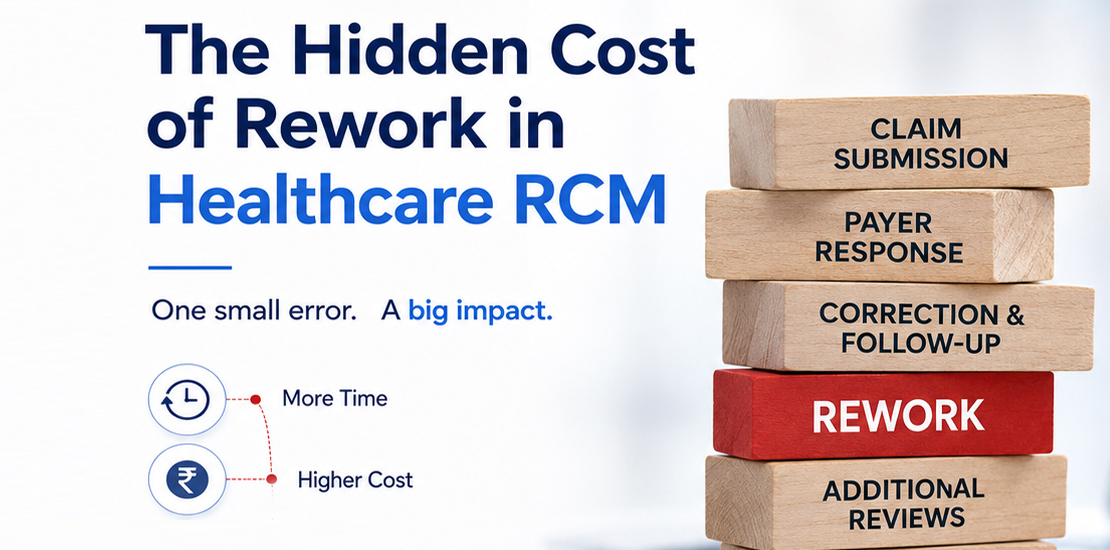
What happens when work has to be done twice?
At first, the answer seems simple: it takes more time.
But in healthcare RCM, the real cost of rework can extend far beyond the additional minutes spent correcting an error.
A claim is processed incorrectly. It needs another review. A QA check is performed. The claim is corrected and resubmitted. The payer responds again. Someone follows up. The account remains open longer. Payment is delayed.
The original error may have taken only a few minutes to make and perhaps a few more minutes to correct.
The operational impact can last much longer.
Rework Is More Than a Quality Issue
This is why rework deserves to be looked at as more than a quality issue.
It is a capacity, cost and process issue.
Rework is essentially any activity that has to be repeated, corrected or revisited because the original work did not produce the intended outcome.
In RCM, that can include:
- incorrect information requiring correction
- claims returned for missing details
- coding that needs re-review
- payment posting errors
- avoidable denials
- repeated payer follow-up
- accounts reopened after closure
Not all rework is avoidable. Healthcare revenue cycles are complex, payer requirements change, and some accounts genuinely require multiple touches.
But that makes an important distinction necessary:
The objective isn’t to eliminate all rework. It is to identify and reduce the rework that the organisation has the ability to prevent.
Why Rework Can Remain Hidden
One reason rework can remain hidden is the way productivity is often measured.
Imagine an employee processes 100 accounts.
The productivity report shows 100 completed accounts.
But suppose 10 of those accounts subsequently require additional work.
The organisation may still report 100 completed accounts, while somewhere else in the operation another employee, team or quality function is spending time correcting those same accounts.
The work has not disappeared.
The cost has simply moved.
Productivity Should Not Be Viewed in Isolation
This is why productivity should not be viewed in isolation.
A meaningful view of operational performance needs to consider productivity alongside quality, first-time-right performance, rework, complexity and turnaround time.
Otherwise, an organisation can unintentionally reward the volume of work entering the system while overlooking how much of that work has to come back through it.
The Rework Chain
That creates what could be called the rework chain.
- Initial processing leads to an error.
- The error is identified.
- The account moves to review.
- A correction is made.
- The claim is resubmitted.
- The payer responds.
- Someone follows up.
- The payment is eventually received.
What looked like one small processing error has now consumed capacity across multiple stages of the revenue cycle.
Why Rework Matters for RCM Leaders
This is where rework becomes particularly important for RCM leaders.
If the same type of error repeatedly requires intervention from multiple teams, the question should not simply be, “How much time did the correction take?”
The better question is:
“How many downstream activities did this one error trigger?”
That is where the hidden cost begins to become visible.
The People Cost of Rework
There is also a people cost.
Repeated correction work can be frustrating for employees. People generally want to feel that their work is moving something forward. When teams spend a significant portion of their day fixing the same avoidable problems, it can create pressure, frustration and process fatigue.
Rework Consumes Organisational Capacity
And there is a practical consequence.
The capacity consumed by rework cannot be used for productive work.
- An employee spending time correcting yesterday’s error is not available to process today’s account.
- A quality team repeatedly checking the same failure is spending less time identifying new risks.
- A supervisor repeatedly resolving the same escalation has less time for coaching and process improvement.
In other words:
Rework doesn’t just consume time. It consumes organisational capacity.
Where Does Rework Originate?
The next question, therefore, is where that rework originates.
It is tempting to attribute rework to employee mistakes.
Sometimes that is the correct conclusion.
But when the same problem appears repeatedly across different employees, teams or shifts, individual capability may not be the primary issue.
The source could be the process itself.
- Perhaps the workflow makes the correct action difficult.
- Perhaps an exception was never incorporated into training.
- Perhaps the SOP is outdated.
- Perhaps the technology doesn’t provide the necessary validation.
- Perhaps information reaches the employee too late.
- Perhaps the quality control detects the error only after several downstream steps have already occurred.
The Solution Depends on the Cause
The distinction matters because the solution depends on the cause.
- If the problem is knowledge, training may help.
- If it is documentation, the SOP may need to change.
- If it is technology, a validation or system control may be appropriate.
- If it is process design, the workflow itself may need to be redesigned.
- And if the work is genuinely complex, the organisation may need to recognise that multiple touches are part of the expected operating model rather than treating them as failures.
“Why Was the Mistake Possible?”
This is why one of the most useful questions a leader can ask is not:
“Who made the mistake?”
but:
“Why was the mistake possible?”
That question changes the management conversation.
It moves the organisation away from assigning blame and toward understanding the system.
Measuring Rework
The measurement of rework does not have to begin with a sophisticated analytics platform.
An organisation can start by understanding four things:
- How much rework are we doing?
- Why is it happening?
- How much additional capacity is it consuming?
- Which causes keep repeating?
From there, rework can be classified, prioritised and addressed.
For example, if a particular error represents a small percentage of total volume but consumes a disproportionate amount of follow-up time, it may deserve more attention than a high-volume issue that is resolved quickly.
Rework Data Can Reveal Hidden Operational Capacity
This is where rework data becomes valuable.
It can reveal hidden operational capacity.
Reducing avoidable rework doesn’t necessarily mean hiring fewer people.
It may mean that the same team can accomplish more because less of its capacity is being consumed by preventable correction work.
That is a much more meaningful way to think about productivity.
Necessary Complexity and Avoidable Failure
The goal, however, should not be to pursue a theoretical zero-rework environment.
That isn’t realistic in healthcare RCM.
The goal is to understand the difference between necessary complexity and avoidable failure.
Necessary complexity should be managed.
Avoidable failure should be reduced.
And recurring failure should trigger a process investigation.
The Hidden Cost of Rework
Ultimately, every organisation pays for rework.
Sometimes it appears directly as additional labour hours.
Sometimes it hides inside overtime, productivity pressure, quality checks, ageing accounts, delayed collections, escalations or employee frustration.
That is what makes it a hidden cost.
The organisation may not see a line item called “cost of rework” on its financial statement, but it is still paying for it.
Every time work has to be done twice, capacity is being consumed twice.
What RCM Leaders Should Ask
The question for RCM leaders is whether that second effort was necessary or whether the process could have been designed to prevent it.
The best work isn’t simply completed quickly.
It is completed the first time correctly, whenever reasonably possible.
And when it isn’t, the most valuable response isn’t simply to fix the work.
It is to understand why the work had to be fixed in the first place.
Follow MedConverge for practical perspectives on healthcare RCM, operational excellence and process improvement.