
- August 19, 2026
- Posted by: medconverge
- Category: RCM
The Industry Most Graduates Ignore Is Quietly Building Global Careers
Every year, thousands of graduates chase the same opportunities.
- Information Technology.
- Banking.
- Digital Marketing.
- Government jobs.
These industries dominate career conversations on college campuses and job portals alike. Yet, one of the fastest-growing global industries rarely receives the attention it deserves.
Healthcare Revenue Cycle Management (RCM).
Ironically, many graduates discover RCM by accident rather than by choice.
- Some join because a friend referred them.
- Others accept an interview simply because it is available.
- Few realise they are stepping into an industry that supports one of the world’s largest healthcare systems and offers long-term career stability, continuous learning and international exposure.
The question isn’t why more people are joining Healthcare RCM.
The real question is: Why aren’t more graduates talking about it?
Healthcare Doesn’t Stop. Neither Does Opportunity.
Economic cycles change.
Industries rise and fall.
Technology reshapes the way organisations operate.
Healthcare, however, remains essential.
Every consultation, every diagnostic test, every surgical procedure and every patient interaction generates administrative and financial processes that ensure providers can continue delivering care.
Behind those processes are Revenue Cycle Management professionals.
- They verify insurance eligibility.
- Review documentation.
- Assign medical codes.
- Manage billing.
- Resolve denials.
- Support compliance.
- Protect revenue.
Their work may happen behind the scenes, but its impact reaches every patient and every healthcare provider.
Healthcare RCM is not simply another business process. It is an integral part of a global healthcare ecosystem.
The Biggest Myth About RCM
Many graduates assume that meaningful careers require years of experience before real growth begins.
Healthcare RCM proves otherwise.
The industry values qualities that cannot always be measured by a résumé:
- Curiosity.
- Discipline.
- Attention to detail.
- Accountability.
- A willingness to learn.
Technical knowledge can be taught.
A professional attitude is far more difficult to develop.
That is why many organisations invest heavily in structured onboarding, mentoring and continuous development.
For graduates who are prepared to learn, progression can begin much earlier than they expect.
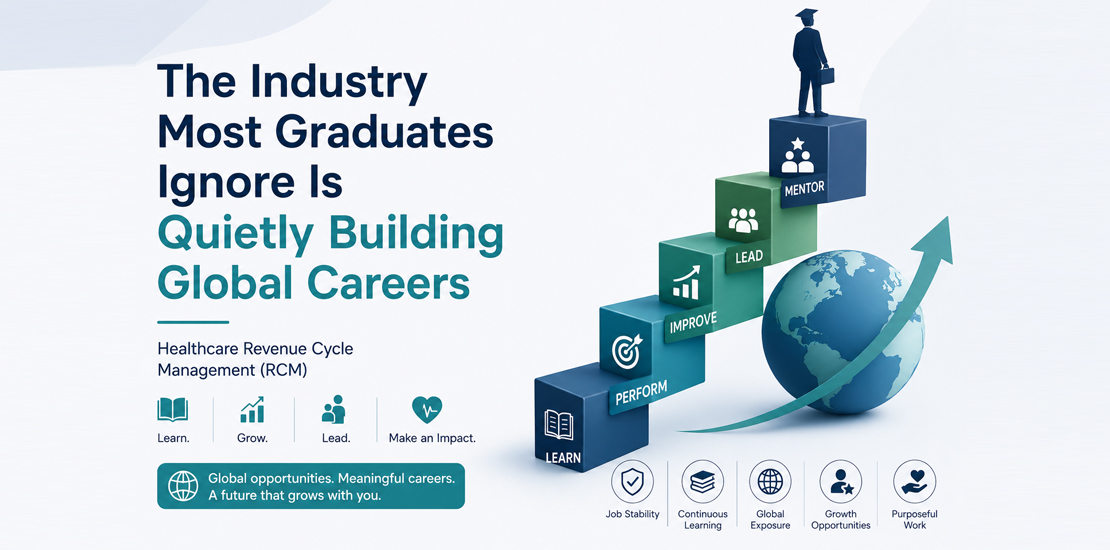
The Career Growth Ladder
One of the misconceptions about Healthcare RCM is that growth is limited.
The reality is very different.
Career progression is rarely defined by how long someone has worked.
It is defined by how consistently they improve.
At MedConverge, we see career development as a journey rather than a promotion.
Stage 1 – Learn
Every career begins with understanding the fundamentals.
- Medical terminology.
- Healthcare processes.
- Insurance guidelines.
- Communication.
- Professional discipline.
Learning creates confidence.
Stage 2 – Perform
Knowledge must translate into consistent execution.
- Accuracy.
- Productivity.
- Reliability.
- Meeting quality expectations.
- Building trust.
Performance establishes credibility.
Stage 3 – Improve
High-performing professionals don’t simply complete tasks.
They ask:
“How can this process become better?”
Continuous improvement separates future leaders from dependable performers.
Stage 4 – Lead
Leadership begins long before receiving a title.
Professionals who support colleagues, share knowledge and solve problems naturally become influential within their teams.
Leadership is earned through contribution.
Stage 5 – Mentor
The strongest professionals create success beyond themselves.
- They coach new employees.
- Share best practices.
- Strengthen team capability.
- Help build the next generation of RCM professionals.
That is where real leadership begins.
The Skills That Stay With You
Many jobs teach people how to complete tasks.
Healthcare RCM develops professionals.
Throughout their careers, employees strengthen abilities that remain valuable regardless of industry.
- They learn to analyse complex information.
- Communicate professionally.
- Interpret regulations.
- Manage time effectively.
- Work collaboratively.
- Solve problems under pressure.
- Adapt to changing client expectations.
Perhaps most importantly, they learn accountability.
These are skills that continue creating opportunities throughout an entire career.
Technology Is Changing Roles, Not Eliminating Them
Artificial Intelligence has become one of the most discussed topics across every industry.
Healthcare RCM is no exception.
- Automation now assists with repetitive administrative work.
- AI identifies inconsistencies.
- Workflow tools improve efficiency.
Yet technology has also highlighted something important.
Critical thinking has become more valuable; not less.
- No technology can replace professional judgement when documentation is incomplete.
- No algorithm can coach a colleague.
- No automation can build trust with a client.
The future belongs to professionals who combine technical knowledge with human judgement.
Success Is Built on Mindset, Not Experience
The professionals who progress fastest often share similar habits.
- They remain curious.
- They welcome constructive feedback.
- They ask thoughtful questions.
- They continuously update their knowledge.
- They take ownership of their work.
Notice what isn’t on that list.
Years of experience.
Experience matters.
Mindset determines how valuable that experience becomes.
Why Organisations Should Invest in Fresh Talent
Recruitment should never focus solely on filling vacancies.
It should focus on building capability.
- Graduates bring energy.
- Adaptability.
- Fresh perspectives.
- Digital confidence.
- The willingness to learn.
When organisations combine these qualities with structured training, strong leadership and a culture of continuous improvement, they create future specialists, quality analysts, trainers and operational leaders.
Developing talent is not simply an HR initiative.
It is a long-term business strategy.
Final Thoughts
Every successful career begins with a single opportunity.
Healthcare Revenue Cycle Management offers graduates far more than employment.
- It offers continuous learning.
- Professional growth.
- Global exposure.
- Purposeful work.
- And the opportunity to contribute to an industry that supports healthcare providers every day.
The organisations that invest in people today will shape the future of Healthcare RCM tomorrow.
Because careers are not built by chance.
They are built through curiosity, consistency and the courage to keep learning.